
Last updated September 20, 2026
Free on-site gate assessment - hinges, posts, and your LiftMaster or Nice gate operator checked before anything is quoted
The assessment is free and the quote is the invoice.
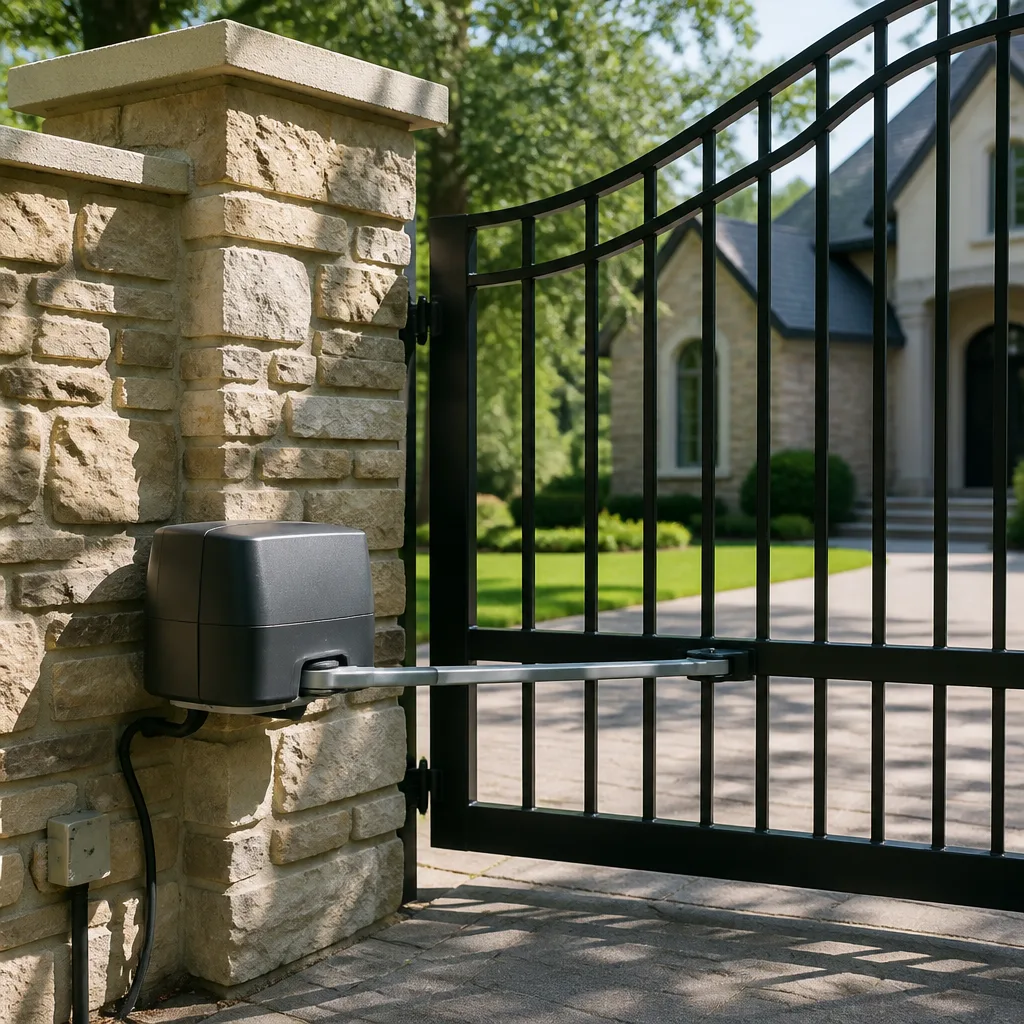
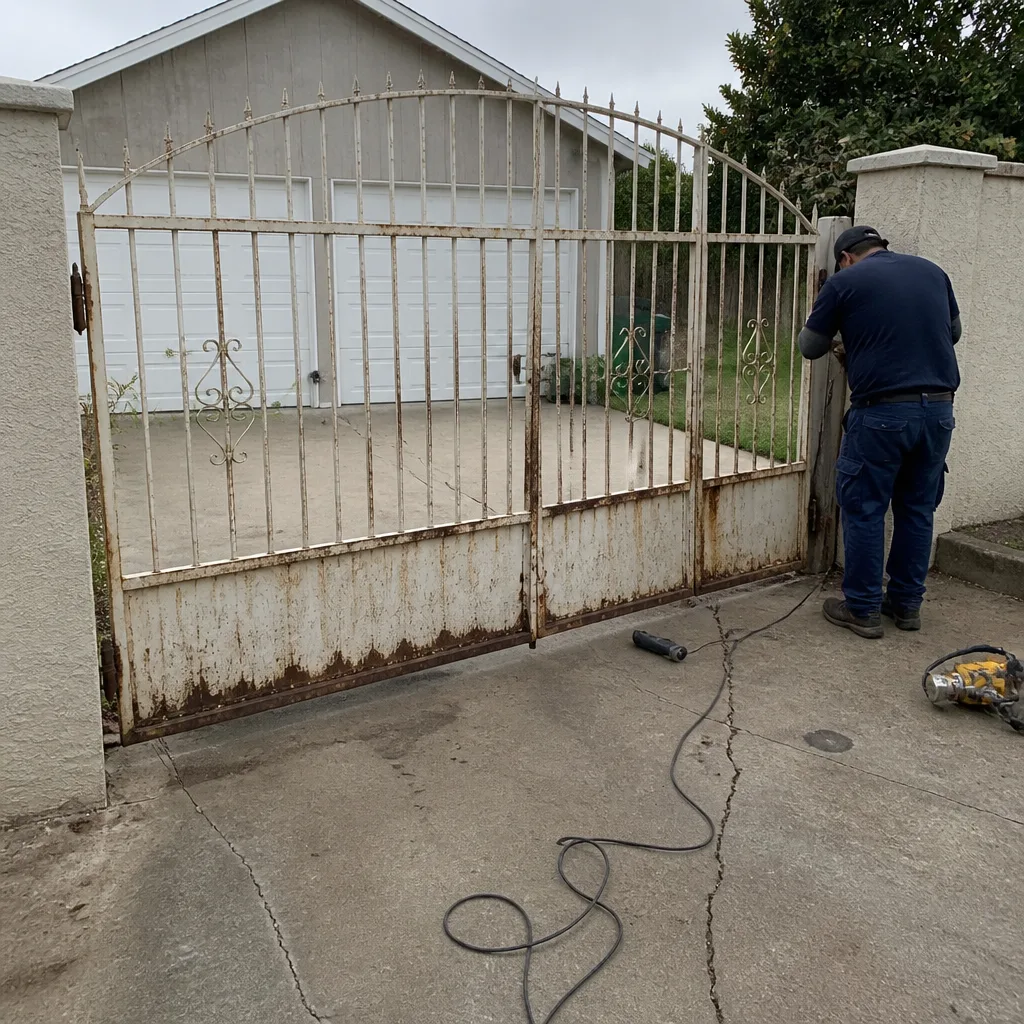 Before
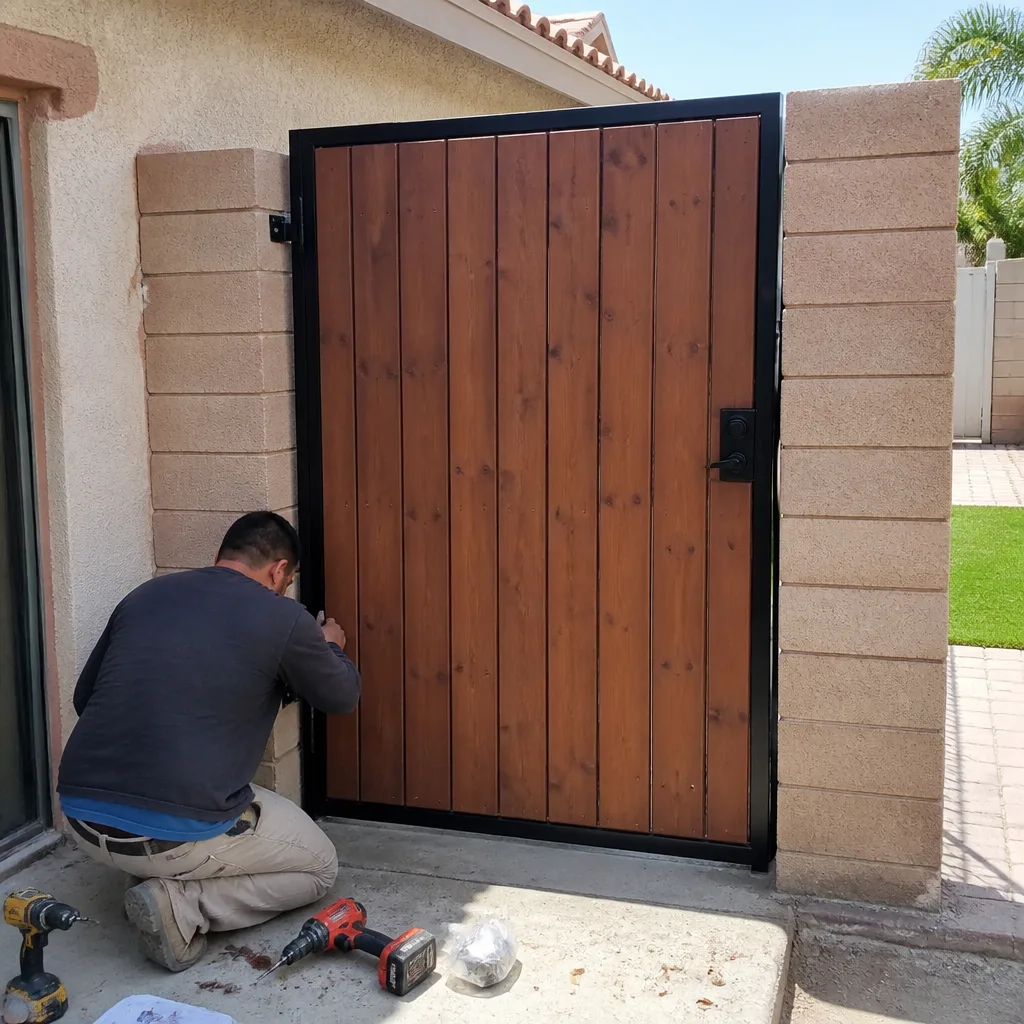 After
After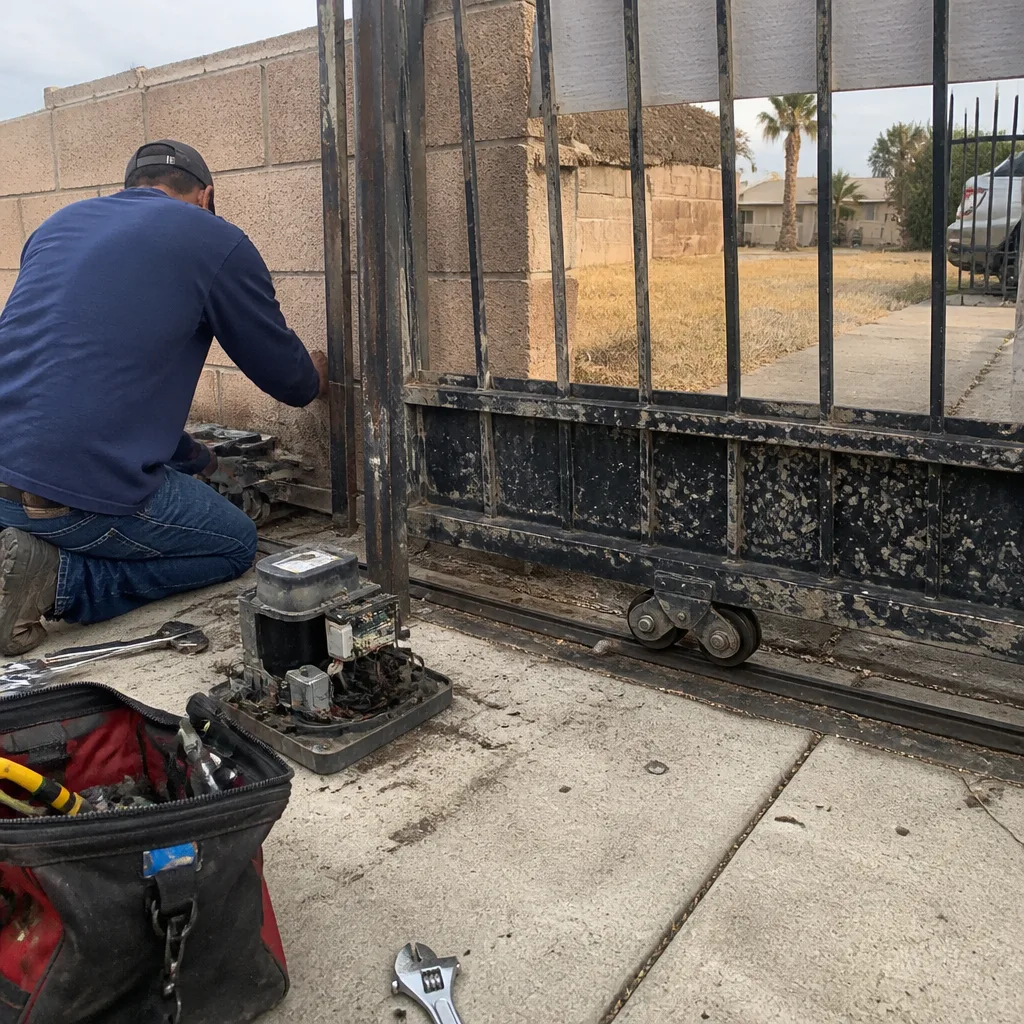 Before
 After
After Before
 After
AfterDIY vs Professional Gate Repair: The Fontana Homeowner’s Decision Guide
There are exactly four gate repairs a Fontana homeowner can do themselves without creating a future liability or a code violation. Everything else has a professional threshold, not because of skill, but because of what has to be recorded when the work is done. A gate that fails twice costs twice, but a gate that fails without documentation costs three times: once for the original repair, once for the rediscovery, and once for the next owner’s bargaining position in a Fontana market where homes change hands every seven years on average. This guide lays out which repairs are genuinely yours, which ones belong to a licensed Gate Repair contractor, and what the difference actually costs you in dollars and future liability.
Quick Answer
DIY gate repair in Fontana is limited to four safe tasks: lubricating hinges and chains, clearing obstruction sensor lenses, resetting limit switches to factory defaults, and replacing remote batteries. Any repair involving gate motors, electrical wiring, hydraulic arms, or structural welding should go to a licensed professional, because those repairs trigger California permit requirements and carry liability if done wrong. Expect to pay $45 to $90 in parts for the four DIY tasks versus $180 to $1,200 for professional repairs, depending on the component and the gate type.
Table of Contents
- The Four Repairs You Can Honestly Do Yourself
- What ‘Permit-Triggering’ Actually Means in California
- The Documentation Gap: What a DIY Fix Leaves Behind
- The Real Cost Comparison: DIY vs Professional
- What a Professional Visit Should Leave Behind
- Fontana-Specific Factors That Change the Math
- Common Mistakes to Avoid
- When to Call a Professional
- Frequently Asked Questions
- The Bottom Line
BeforeAfterThe Four Repairs You Can Honestly Do Yourself
Let’s be direct about what a homeowner in Fontana can safely handle on a residential gate. We’ve been called out to thousands of gates since 2014, and we have never once told a homeowner they shouldn’t have lubricated their own hinges. What we have seen is the aftermath of someone who decided the motor looked “simple enough” and now has a gate that won’t budge and a wire harness with three cut leads. Here is the complete list, with the exact conditions under which each is safe.
- Lubricating hinges and chains. Use a white lithium grease on hinge pins and a dry graphite or PTFE spray on chains. Do not use WD-40, which washes out the existing grease and attracts dust in Fontana’s dry, windy conditions. This is a 15-minute job, safe as long as you keep your hands clear of pinch points and the gate is in manual mode before you start.
- Clearing obstruction sensor lenses. A photo-eye (the infrared beam that stops the gate if something crosses the path) gets a film of dust and spider silk on its lens after a Fontana Santa Ana wind event. Wipe the lens with a dry cloth. If the beam realigns and the gate closes, you’ve solved a $95 service call for free. If wiping doesn’t fix it and the alignment is visibly off by more than a pencil’s width, stop there: you have a mounting bracket issue, not a cleanliness issue.
- Resetting limit switches to factory defaults. Most residential operators have a documented factory reset sequence in the manual, usually involving holding two buttons on the control board for a ten-count. This fixes gates that open too far, stop short, or reverse halfway. It does not fix a gate that has a mechanical obstruction or a failing capacitor. Reset once. If the symptom returns within a week, the limit switch is not the problem.
- Replacing remote batteries. A gate remote that blinks weakly or works only from ten feet away needs a CR2032, A23, or 9V battery, depending on the model. Check the old battery for the number, replace it, and retest from your car. If a fresh battery doesn’t restore range to at least 50 feet, the receiver board on the gate operator is failing, and that is a professional repair.
Anything else, and we mean anything else, crosses the line. Capacitor swaps, gear replacements, chain tension adjustments, hinge welding, motor rewiring, circuit-board-level work: these are not in the homeowner’s domain. It’s not about intelligence. It’s about what failure looks like when the gate weighs 400 pounds and is moving under power.
What ‘Permit-Triggering’ Actually Means in California
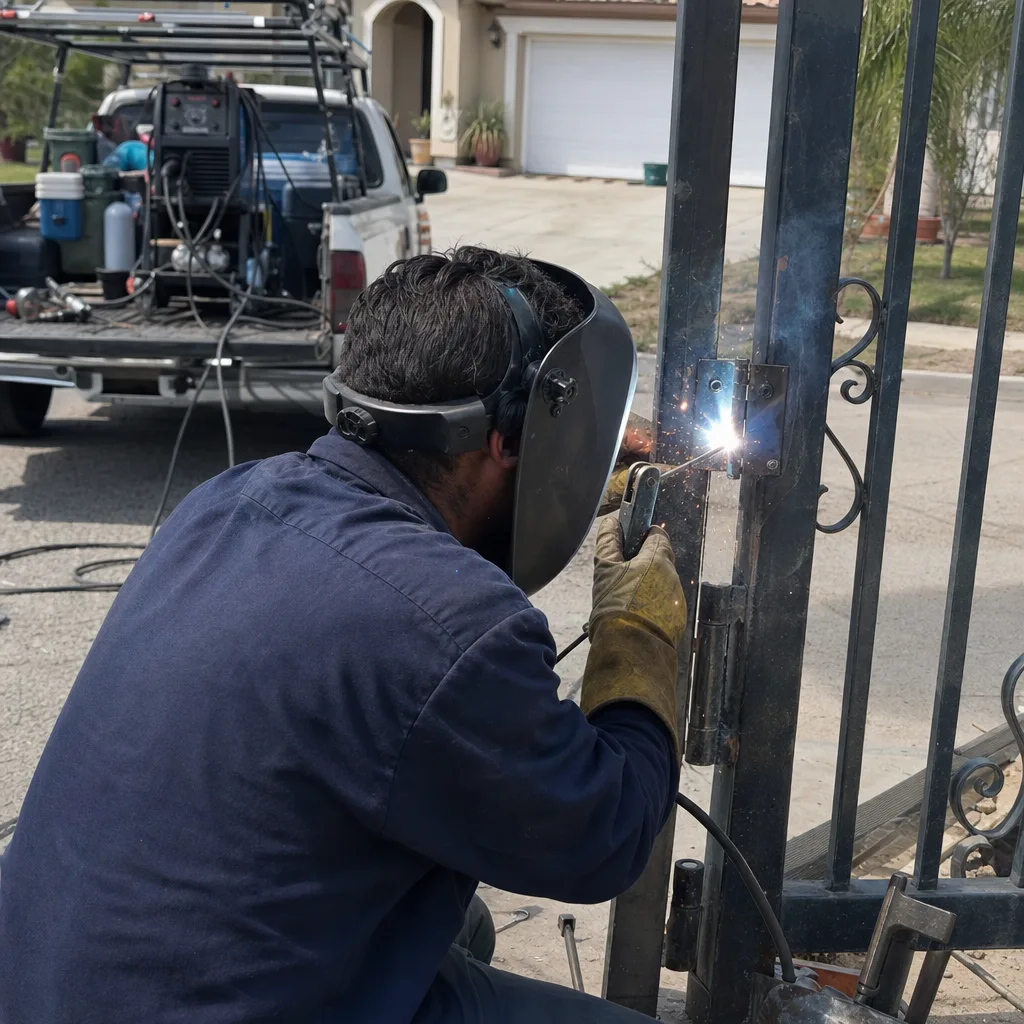
Most guides hand-wave at “check local codes” and move on. That’s not useful. Here’s what the term means in practice for a Fontana homeowner.
A permit-triggering repair is one that alters the gate’s electrical system, its structural support, or its means of egress in a way that a building inspector would need to verify meets current California Building Code (CBC) and California Electrical Code (CEC). In plain English: if you are changing wiring, adding or moving an operator, modifying the gate’s frame or mounting points, or converting a manual gate to automated, you are doing permit-triggering work. California’s Contractor State License Board (CSLB) requires a C-10 electrical contractor license or a C-61/D-28 gate and door contractor license for this scope. A homeowner can legally pull a permit for work on their own property, but here’s the part that never makes it into the online guides: when you pull a homeowner permit, you take on the liability for every code compliance detail, and your homeowner’s insurance policy may specifically exclude coverage for injuries or damage resulting from unpermitted or DIY electrical work. We’ve reviewed three policies in the last year that had an explicit exclusion rider for self-performed gate motor repairs. None of those homeowners knew it until after the claim.
Fontana’s specific enforcement posture matters too. The city has a substantial stock of homes built between 1990 and 2010 in neighborhoods like Sierra Lakes, Hunter’s Ridge, and Southridge, and a meaningful share of those automatic gates have been modified or added post-construction. When a home goes up for sale, the buyer’s inspector will check for the gate operator’s compliance with UL 325 (the entrapment-protection standard). A DIY operator swap without updated photo-eyes and a pressure-sensing edge is exactly the kind of finding that shows up on an inspection report and becomes a $600 to $1,200 seller concession. The permit is not the expensive part. The discovery is.
The Documentation Gap: What a DIY Fix Leaves Behind
We’re going to make a case that no other Fontana gate company makes, because it doesn’t serve their booking calendar. Here it is: the most expensive problem in residential gate repair is not the broken part. It’s the missing history.
When a homeowner replaces a gear, resets a board, or re-tensions a chain themselves, they produce no record. No photo. No wiring diagram. No note about which setting was changed and why. Six months later, the gate fails again, or the house sells, and the next technician shows up to a machine that has no known history. That technician has to work backward. Full diagnostic rate, usually $75 to $125 in Fontana, just to reconstruct what the homeowner already knew and didn’t write down. On top of that, if the issue is intermittent, the tech may spend an additional half-hour recreating the failure conditions. The metered cost of missing documentation is real and recurring.
Compare that to a professional repair under The Haven Standard, the documentation protocol we follow on every single job. On any visit, we leave a written scope of the exact problem, a written price that was agreed before the repair, a photo log of what we found, what we adjusted, and what we installed, and the part number of every component replaced. The homeowner keeps a copy. We file a copy in the job record. If the gate fails again, any future technician, including a different company, has the full history. That’s not a warranty. That’s a liability shield, and in Fontana’s high-turnover market, it converts directly into money at closing time.
The Real Cost Comparison: DIY vs Professional
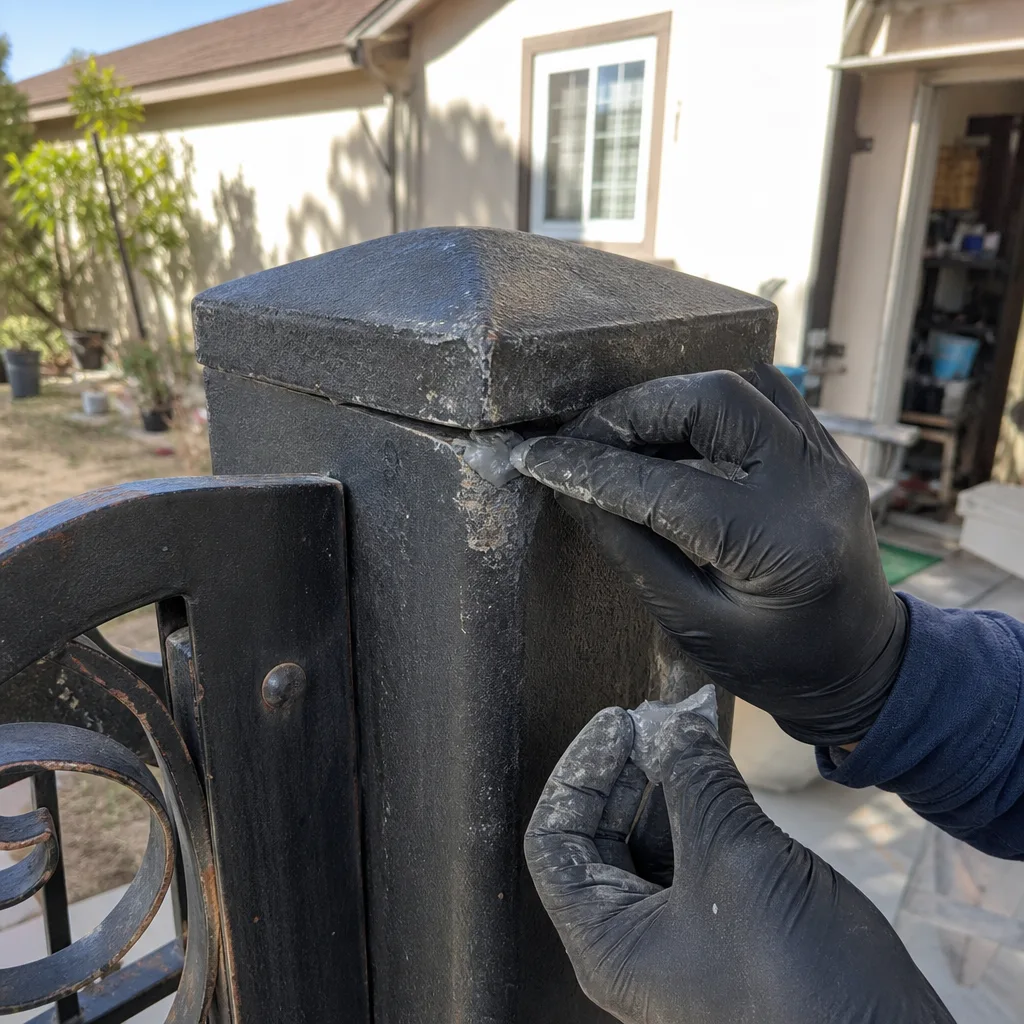
The DIY-versus-professional question is almost always framed around cost, and that framing is incomplete; for deeper context, see our Gate Repair Cost Breakdown: The Fontana Homeowner’s Reference for 2026. Yes, a $12 can of lithium grease is cheaper than a $129 service call. But that comparison treats the gate as if it exists in isolation. Here’s the actual math for the five most common gate repairs in Fontana.
- Hinge lubrication: DIY cost $12 to $18 (grease and a rag). Professional lube service $85 to $125. But if the hinge is worn, not dry, lubrication buys you 60 to 90 days before the pin seizes and the gate cants, at which point you’re looking at $350 to $650 for a hinge replacement. A professional inspection catches the worn pin during the lube visit.
- Photo-eye cleaning: DIY cost $0. Professional cleaning as part of a tune-up $89 to $150. If the real issue is a misaligned bracket from a car bump, the professional fix is $110 to $190. If you DIY-clean a lens without fixing the bracket, the gate stops again within a week.
- Remote battery replacement: DIY cost $4 to $12. Professional battery replacement $15 to $25 if you bring it to a shop, $75 to $100 as a dispatch visit. Worth DIYing every single time, unless the remote is also damaged or the receiver range is degraded.
- Limit switch reset: DIY cost $0. Professional reset $95 to $130. A reset that “fixes” the problem for three days and then fails again means you have a failing limit switch module ($180 to $340 installed) or a control board issue ($350 to $800 installed). The DIY reset didn’t fail. It just didn’t address the root cause, and the root cause is now six days closer to total failure.
- Gear or chain drive replacement: DIY cost $60 to $180 in parts, plus whatever your time is worth, plus the tool purchase if you don’t already own a torque wrench and snap-ring pliers. Professional cost $280 to $600. This is the clearest case for professional work, because a chain that’s one link too tight or a gear that’s half a tooth out of mesh will destroy the new part in weeks.
The honest framing: DIY saves money on the four safe tasks and costs more money on everything else, once you account for rework, diagnostic reconstruction, and the warranty you’re not getting. Every professional repair from us at Vance Gate Repair Fontana carries a 365-Day Done Right Promise. Your own DIY job carries your own promise, and when it fails, you are both the technician and the one paying the second invoice. For more detail on the scope of professional repair services, see our Vance Gate Repair Fontana home page.
What a Professional Visit Should Leave Behind
This is the section that separates a real gate company from a guy in a truck with a multimeter. A professional gate repair in Fontana should produce three things before the technician leaves, every single time. If your current company doesn’t, you’re leaving money on the table.
First, a written scope and a written price. Not a verbal estimate. Not a “we’ll see when we get in there.” A flat price, in writing, agreed before any work starts. Under Clause 1 of The Haven Standard, the written price is delivered before a tool comes out of the truck. If the scope changes because a new problem is discovered mid-repair, the new price is written and agreed before the new work begins. You should never, ever sign a blank check for a gate repair.
Second, a photographic record. Before we leave, you get a photo log: what the inside of the operator looked like when we opened it, what the limit switch reading was before and after adjustment, what the new part looks like installed, and what the wiring connections look like with the new component in place. That’s Clause 4 of the Haven Standard, Evidence on every job. Why this matters in Fontana specifically: when your neighbor’s gate company leaves no evidence, and your gate company leaves a full photo set, and both gates look the same from the street, you have an asset at sale time that your neighbor does not. A buyer can have a reasonable expectation that a gate with documentation has been maintained. A gate with no history is an unknown, and unknowns get discounted.
Third, a part number. Too many companies install a generic part and write “replaced motor” on the invoice. Six months later, the motor fails under warranty, and nobody can identify what was installed. Every Vance repair includes the manufacturer part number, the date of installation, and the date of purchase, written on the invoice and photographed in the install. You’ll know exactly what’s on your gate, and so will any future technician. If you’re considering a full Gate Installation in Fontana, insist on the same standard: written price, photo record, part numbers.
Fontana-Specific Factors That Change the Math
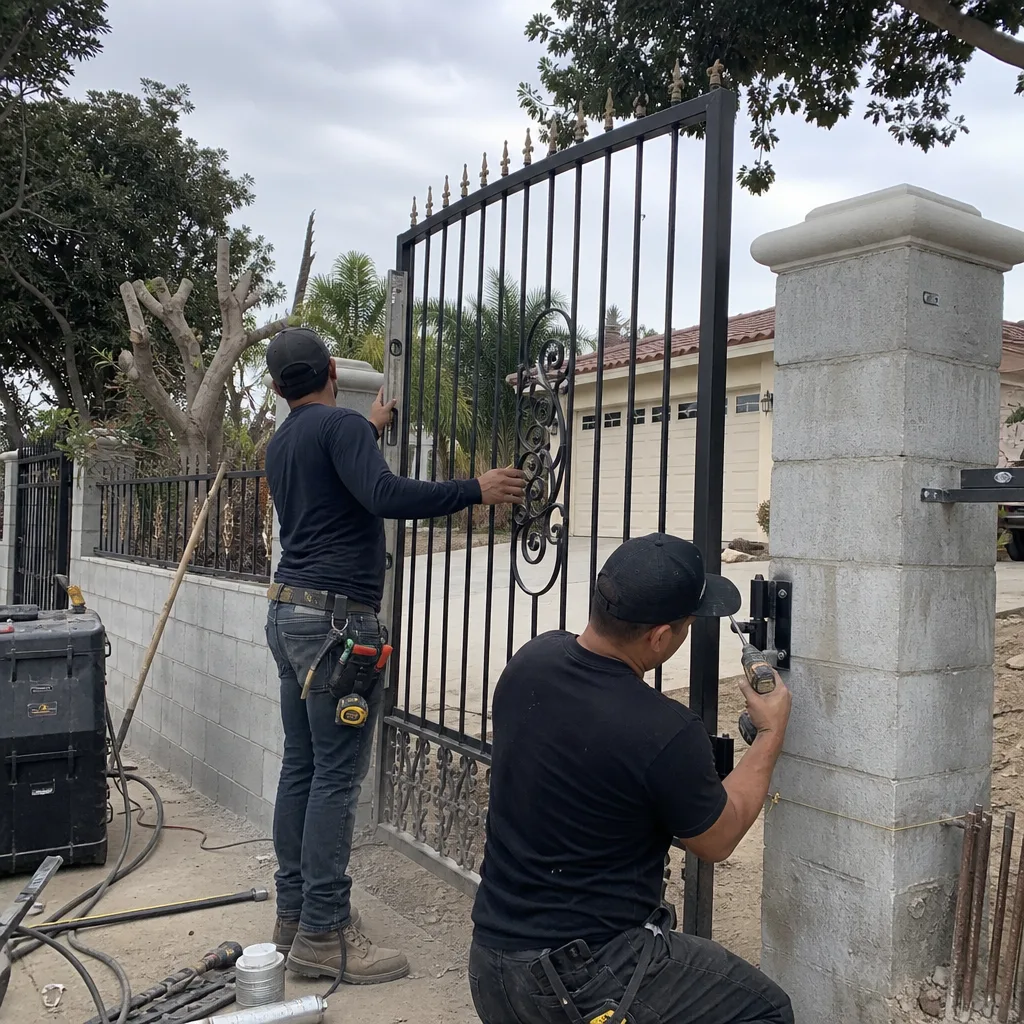
Fontana isn’t a generic Southern California suburb when it comes to gates. Three factors shape the DIY-versus-professional calculus here more than any national comparison chart will show you.
The wind. The Santa Ana winds, which blow through the Cajon Pass and down into Fontana between September and February, are a genuine mechanical force. We regularly see gates in Gate Motor and Opener in Fontana service calls that have been physically blown off their tracks or had their photo-eyes knocked out of alignment by wind-blown debris. A gate that operates fine on a calm day may fail dramatically on a 50-mph gust day, because the wind loads the gate against its stops and the operator’s current sensor reads the resistance as an obstruction. This is a safety concern first: an improperly adjusted operator on a windy day can buckle a gate panel or snap a chain. If your gate is older and has not had its force settings calibrated for Fontana’s wind corridor conditions, a professional adjustment is $120 to $180, and it’s worth every dollar.
The soil movement. Fontana sits on alluvial fan deposits that shift and compact unevenly, and we see the result in gate posts that migrate out of plumb, especially in the northern sections of the city where the ground is looser. A DIY hinge lubrication will not fix a gate that binds at the latch because the post has leaned 3/8 of an inch out of square. That’s a piering and re-setting job, $450 to $900 depending on the post material and the gate weight. You cannot shim your way out of a foundation problem.
The transfer market. Fontana has a median homeownership tenure well below the national average, and a meaningful share of homes in the 2005 to 2015 build years are now on their second or third owner. Every one of those transfers included a home inspection, and every one of those inspections includes the automatic gate if there is one. A gate with no documentation is a line item on the inspection report. A gate with a full Vance photo log and written service history is a selling point. That’s not gate repair. That’s asset management, and it’s the cheapest part of the whole gate.
Common Mistakes to Avoid
- Using WD-40 on the chain. We see this on roughly a third of all Fontana service calls. WD-40 is a solvent, not a lubricant. It strips the chain’s existing grease, and in Fontana’s dry, dusty conditions, the bare chain attracts grit and wears twice as fast. Use chain-specific dry lube or graphite spray instead.
- Adjusting the force settings to fix a mechanical problem. If the gate is binding, the operator’s force sensor will trip and the gate will reverse. Cranking the force dial up to “fix” it means the gate will now push through an obstruction, including a child or a pet. That’s a UL 325 compliance violation with legal liability attached. Fix the binding. Do not override the safety.
- Buying a universal remote without checking compatibility. Fontana homes have a mix of LiftMaster, FAAC, BFT, and Linear operators, and universal remotes do not work reliably across all four. The $25 universal remote you buy at the hardware store has a 30% chance of working with your specific receiver board. Check the operator’s brand and model number before you buy, or call us instead of wasting the trip.
- Ignoring a slow-to-open gate. A gate that takes three seconds longer to open than it did six months ago is telling you something. Slow operation usually means a failing capacitor, a low-fluid hydraulic system, or a gear train that’s chewing itself up. All three are cheaper to fix early. All three become four-figure repairs if ignored.
- Not photographing the “before” state. If you do decide to DIY, take a photo of every wiring connection, every limit switch position, every setting before you touch anything. The single most common DIY failure we see is the homeowner who disconnects three wires and cannot remember which terminal they came from.
- Assuming the gate won’t hurt you. A residential gate under power has enough mechanical advantage to break fingers, crush hands, or pin a child against a post. Never work on an automated gate without disconnecting the power and engaging the manual release first. Never reach into a moving gate’s pinch point for any reason. This is not paranoia. It’s the minimum baseline.
When to Call a Professional

Call a professional if any of these describe your gate: the motor runs but the gate doesn’t move, the gate reverses mid-travel with no obstruction, the chain is visibly sagging or has broken, the gate is out of plumb or scrapes the ground, the control board shows error codes, the gate hums but won’t start, or you’ve done a DIY fix and the same symptom returned within a month. Any of these means the problem is beyond the four safe DIY tasks. Call us at (951) 476-1539. We answer live, 24 hours a day, and we’ll give you a free estimate for the repair in Fontana, in writing, before you commit to anything. You can also follow our Gate Repair Maintenance Checklist for Fontana Homeowners to stay ahead of common issues.
Frequently Asked Questions
Most residential gate repairs in Fontana run between $180 and $600, with specific ranges depending on the component: hinge lubrication $85 to $125, photo-eye realignment $110 to $190, limit switch replacement $180 to $340, gear or chain drive replacement $280 to $600, and control board replacement $350 to $800. The price is always quoted and agreed in writing before any work starts, so you’ll never get an invoice that’s larger than the number you approved. Call (951) 476-1539 for an exact quote.
You can legally perform the four safe maintenance tasks: lubrication, sensor cleaning, limit-switch resetting, and remote battery replacement. Structural, electrical, and operator-level repairs are permit-triggering work under California code, and while a homeowner can technically pull a permit for self-performed work, most homeowners’ insurance policies exclude coverage for DIY electrical repairs. We recommend a licensed contractor for any repair involving wiring, motors, hydraulics, or structural steel.
Photo-eye misalignment is the most common service call we respond to in Fontana, typically caused by Santa Ana wind events knocking the mounting brackets out of position, and it’s an $85 to $190 repair depending on whether the bracket needs replacement. Misaligned photo-eyes are also the primary cause of a gate that starts closing and then reverses, because the safety system reads the loose beam as an obstruction.
Most residential gate repairs in Fontana take between 45 minutes and three hours, depending on the component and whether parts are stocked on the truck. Our service vans carry the most common LiftMaster, FAAC, BFT, and Linear components, so the majority of repairs are completed in a single visit without waiting on a parts order. We’ll tell you the expected duration when we give you the written estimate.
The parts are often the same manufacturer components, but the difference is the warranty and the documentation. When we install a part, you get the manufacturer part number on the invoice, a photo of the installation, and a 365-Day Done Right Promise covering the repair. If the part fails, we make it right at no additional charge. A DIY part carries only the manufacturer’s warranty, which often excludes installation error, and you are the one who has to diagnose and remove it if it fails.
Replacing an entire gate or automating a previously manual gate triggers a building permit in the City of Fontana under the current California Building Code. Repair work on existing operators, such as replacing a limit switch, gear, or control board, typically does not require a permit. If you’re unsure, call us, and we’ll tell you the permit status of your specific repair during the free estimate.
The Bottom Line
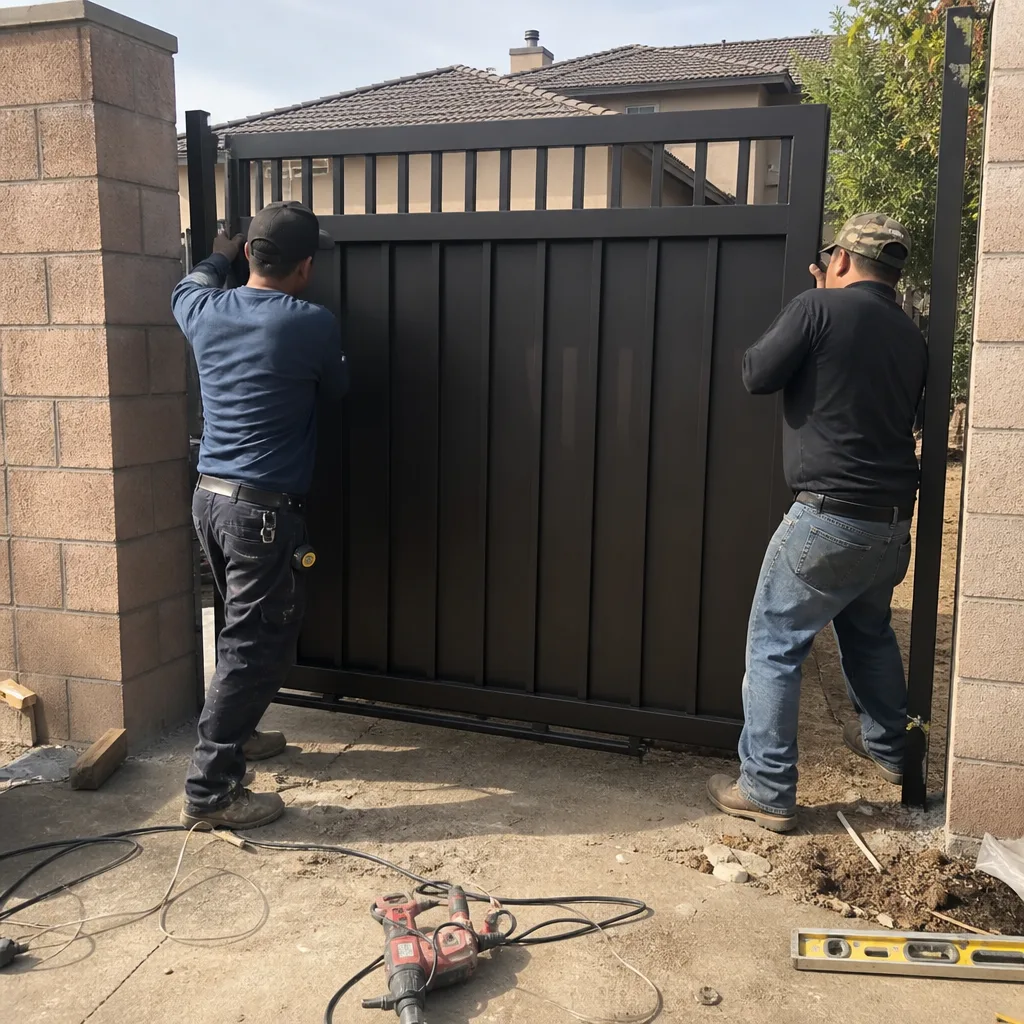
The DIY-versus-professional gate repair question comes down to this: four tasks are truly DIY-safe, and every other repair carries a documentation, liability, or safety threshold that makes the “savings” an illusion. In Fontana, where the wind stresses your gate four months of the year, the soil moves your posts, and the housing market churns your property value every seven years, a gate with no paper trail is a future expense pretending to be a past savings. Do the small maintenance yourself. For everything else, get a written price, get a photo record, and get a gate that any future buyer or technician can understand without paying to rediscover. Browse our more guides & resources for additional homeowner support. Call Vance Gate Repair Fontana at (951) 476-1539 for a free, written estimate on any gate repair, any brand, any time.
Written by Adrian Vance, Owner at Vance Gate Repair Fontana, serving Fontana since 2014.