
Last updated September 20, 2026
Free on-site gate assessment - hinges, posts, and your LiftMaster or Nice gate operator checked before anything is quoted
The assessment is free and the quote is the invoice.

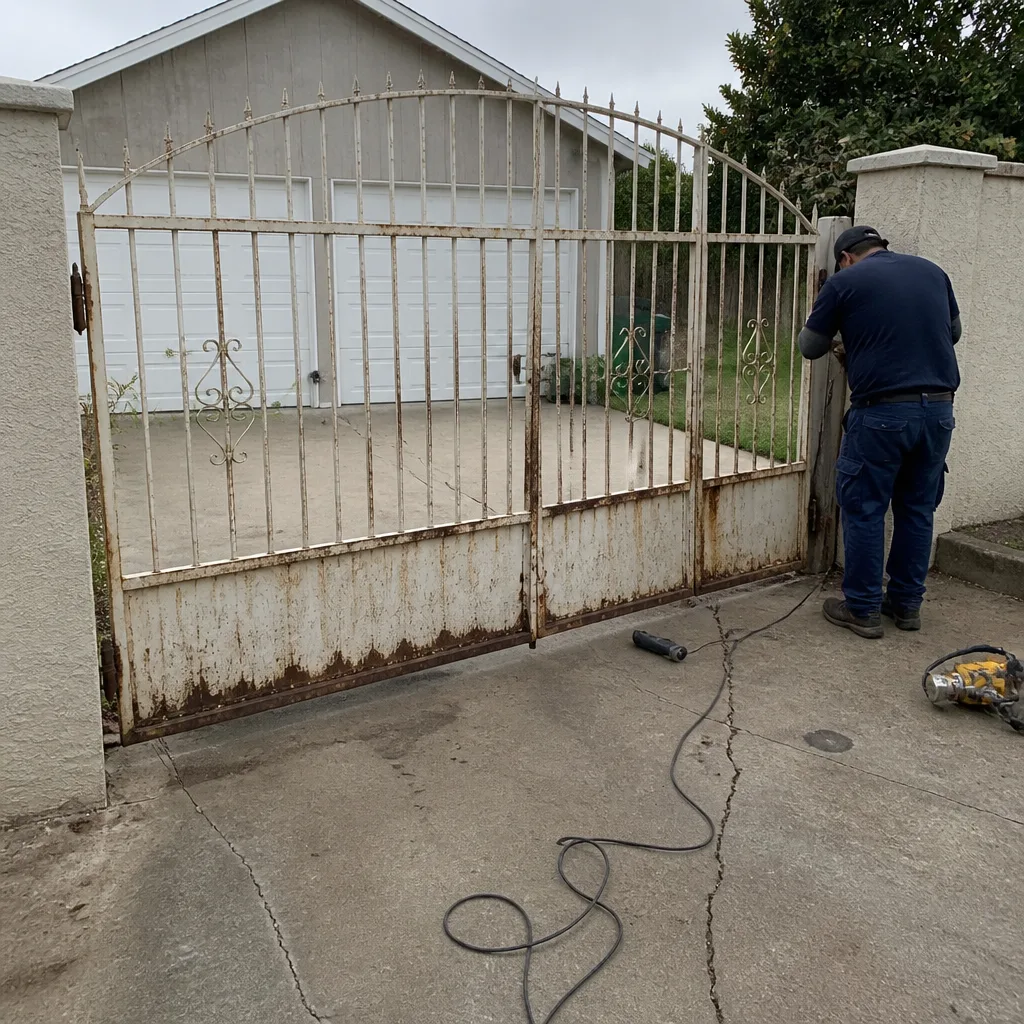 Before
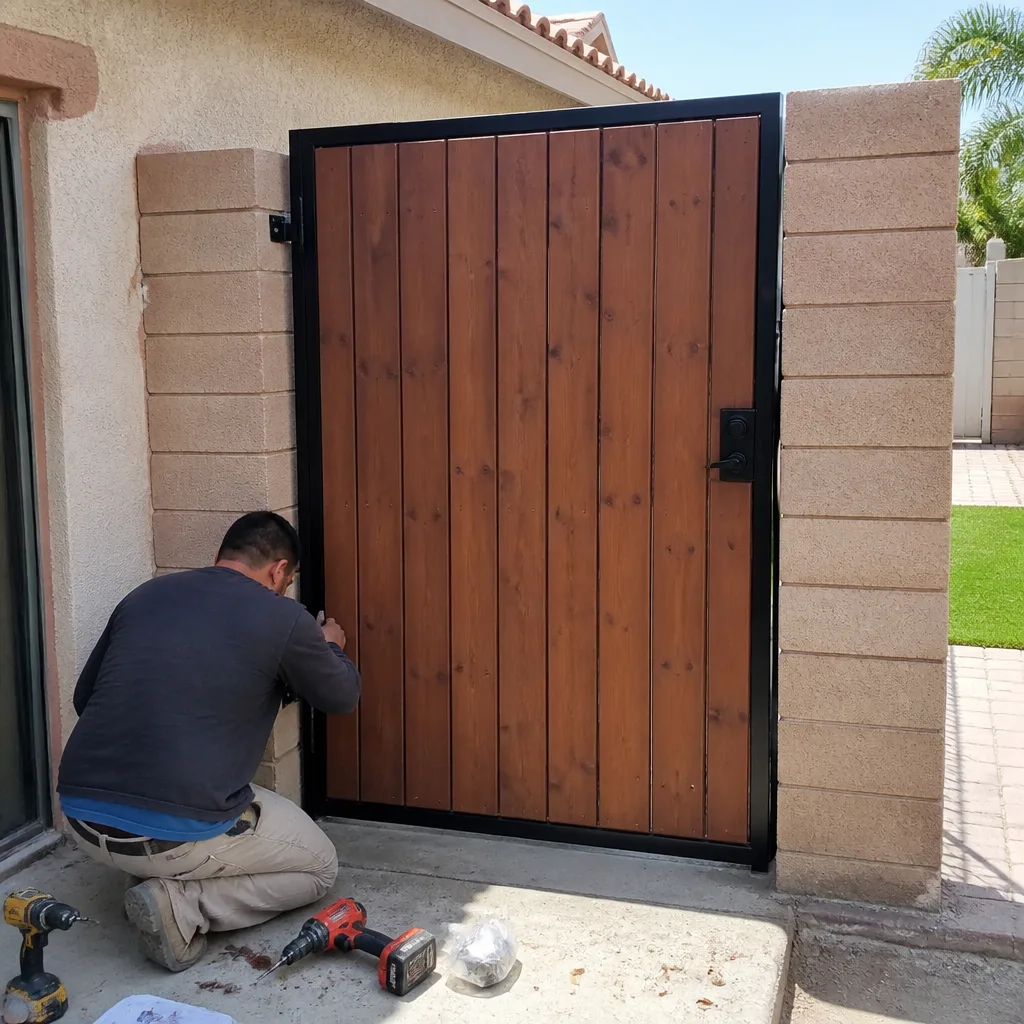 After
After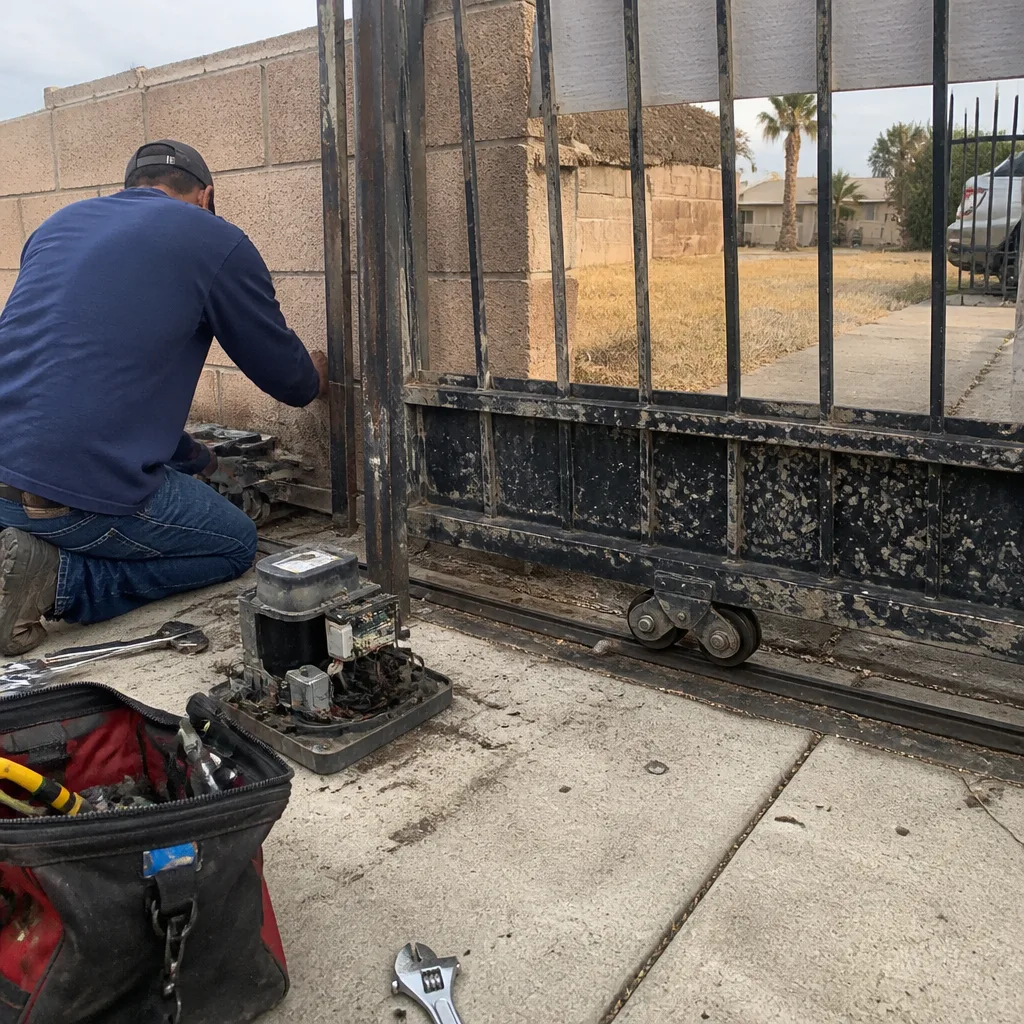 Before
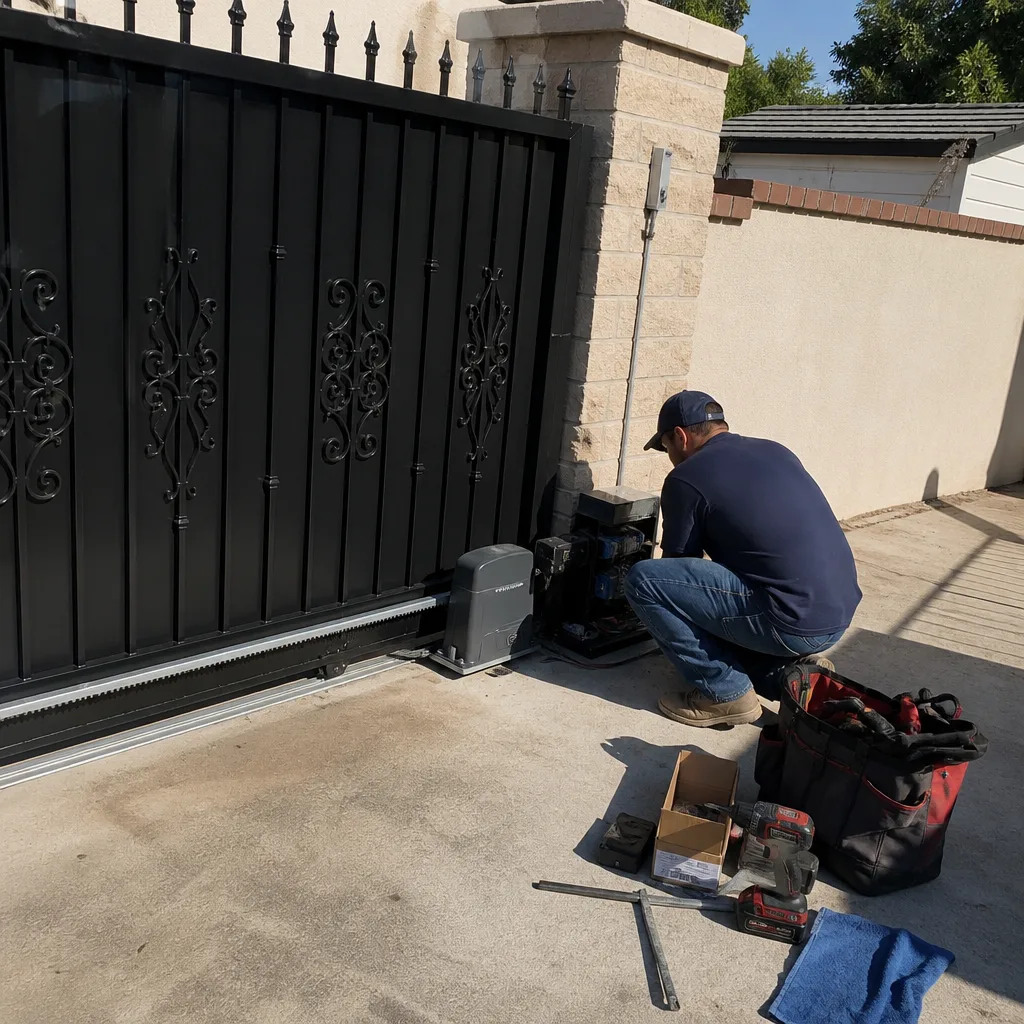 After
After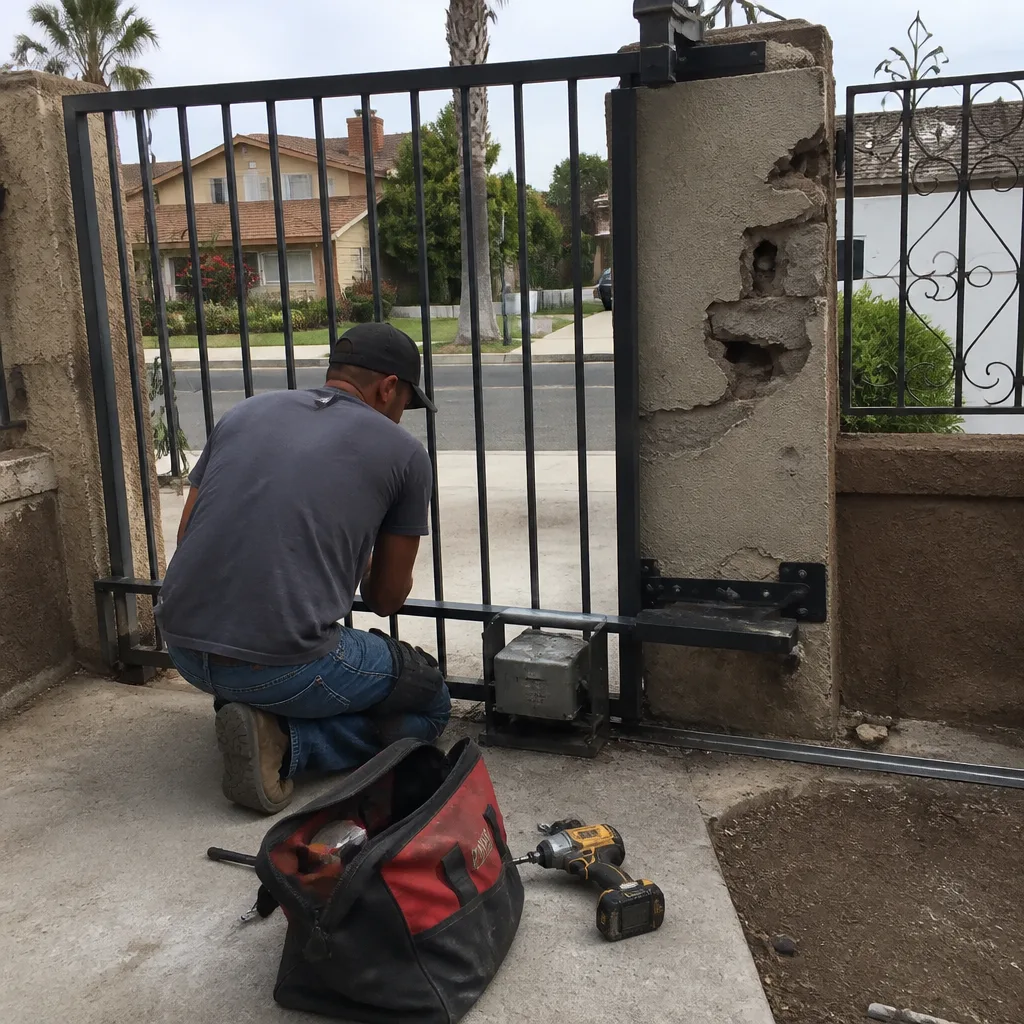 Before
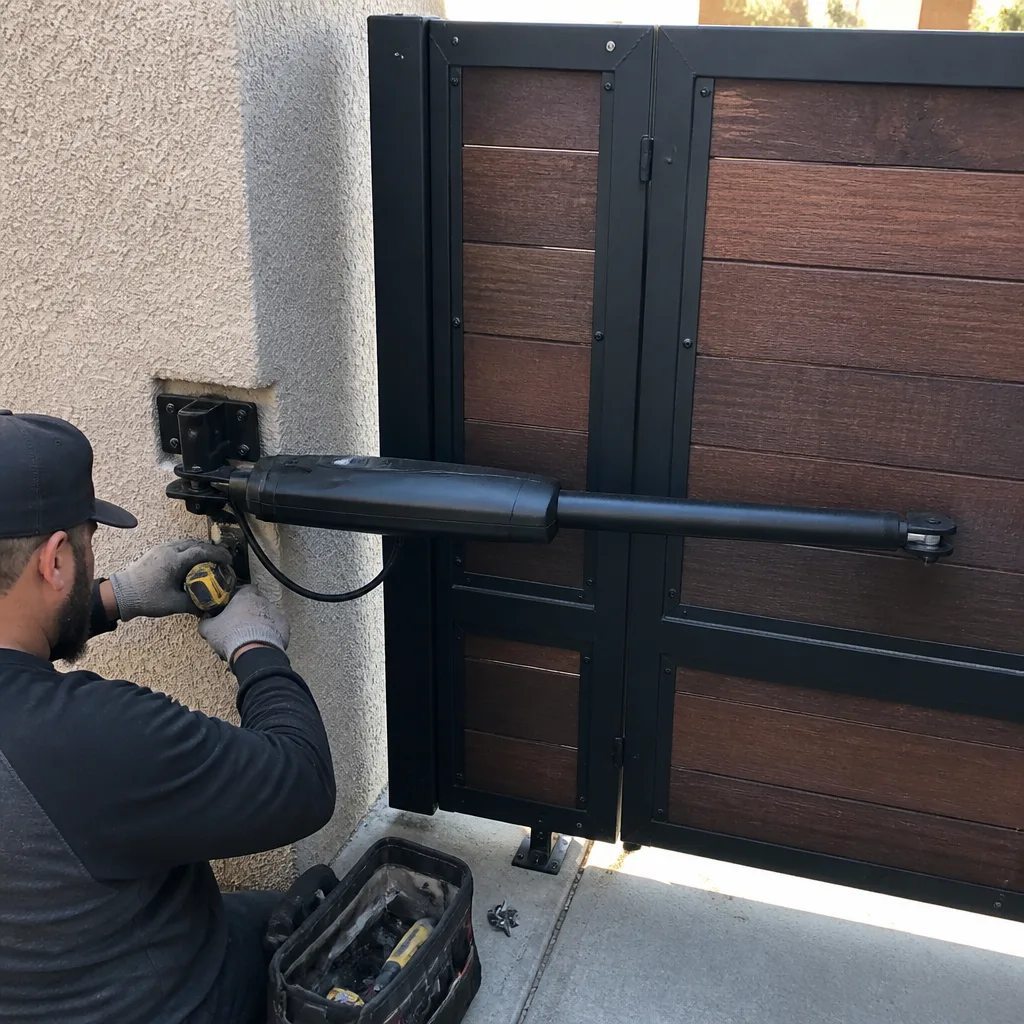 After
AfterGate Repair Maintenance Checklist for Fontana Homeowners
The majority of emergency gate calls across the Inland Empire trace back to deferred maintenance that a homeowner could have caught with a flashlight, a torque wrench, and ten minutes of attention. The problem isn’t lack of effort. It’s that most maintenance checklists are built around calendar months, not actual wear events. Fontana gates fail on a schedule set by Santa Ana wind events, summer heat spikes that push 105°F onto black steel, and the occasional hard rain that washes bedding material out from under a gate post. This guide replaces the generic monthly checklist with something specific to how gates actually deteriorate in Fontana, complementing Gate Repair Warning Signs: A Fontana Homeowner’s Reference Guide. You’ll learn what to check after each local weather event, which measurements to record so you have a baseline, what lubrication actually works in dry desert air, and how to hand a technician a maintenance history that saves you diagnostic labor on the next service call.
Quick Answer
A useful Fontana gate maintenance checklist is event-triggered, not calendar-triggered. After every Santa Ana wind event, check hinge bolts, operator arm brackets, and limit-switch drift within 48 hours. After heavy rain, inspect gate post bedding, bottom track clearances, and junction box seals. Record four baseline measurements at least twice a year: hinge gap, chain slack, limit-switch position, and battery voltage. Then keep a written log of every observation so any technician who arrives can skip re-diagnosing your gate and confirm the problem in minutes instead of an hour.
Table of Contents
- Why Event Triggers Matter More Than Calendar Months in Fontana
- The 10-Minute Visual Pre-Check That Catches 80% of Developing Problems
- What to Check Within 48 Hours After a Santa Ana Wind Event
- What to Check After a Hard Rain or Wash-Out
- The Four Baseline Measurements Every Fontana Homeowner Should Record
- Lubrication in Fontana’s Dry, Dusty Climate: Type, Interval, and Method
- The Maintenance Log: What to Hand a Technician When They Arrive
- Common Mistakes to Avoid
- When to Call a Professional
- Frequently Asked Questions
- The Bottom Line
BeforeAfterWhy Event Triggers Matter More Than Calendar Months in Fontana
Most gate maintenance guides tell you to inspect monthly, lubricate quarterly, and service annually. That advice works in coastal climates where temperature swings are modest and wind is predictable. Fontana is different. The city sits against the Cajon Pass, which funnels Santa Ana winds down from the high desert at sustained speeds that routinely exceed 30 mph with gusts past 60. Those winds carry fine sand and grit that works into hinge pins, chain rollers, and limit-switch housings. A gate that operates cleanly on a calm October morning can have measurable hinge wear by the time the third wind event of the season passes through.
Summer heat adds a second stressor. Ambient temperatures above 100°F soften grease, causing it to migrate out of pivot points and onto the gate frame where it collects dust. The thermal expansion of steel gates can shift limit-switch alignment by enough to alter travel distance by a quarter inch or more. We’ve measured limit-switch positions before and after Fontana heat waves and seen drift that would eventually cause an operator to stall mid-cycle or slam the gate against the open stop.
Rain is the third trigger, though it arrives less often than in other Southern California cities. When it does, Fontana’s alluvial soil drains quickly on the surface but erodes beneath gate posts if water pools around the base. One hard rain can leave a wheeled gate’s track rail unsupported over a two-inch void, which causes the gate to sag under its own weight and put binding stress on the motor.
The smarter approach is to inspect after each trigger event, not on a fixed date. A homeowner who checks their gate after every Santa Ana event and every significant rain will catch problems months before the homeowner who waits for the next “scheduled” inspection. That’s what this checklist is built around.
The 10-Minute Visual Pre-Check That Catches 80% of Developing Problems
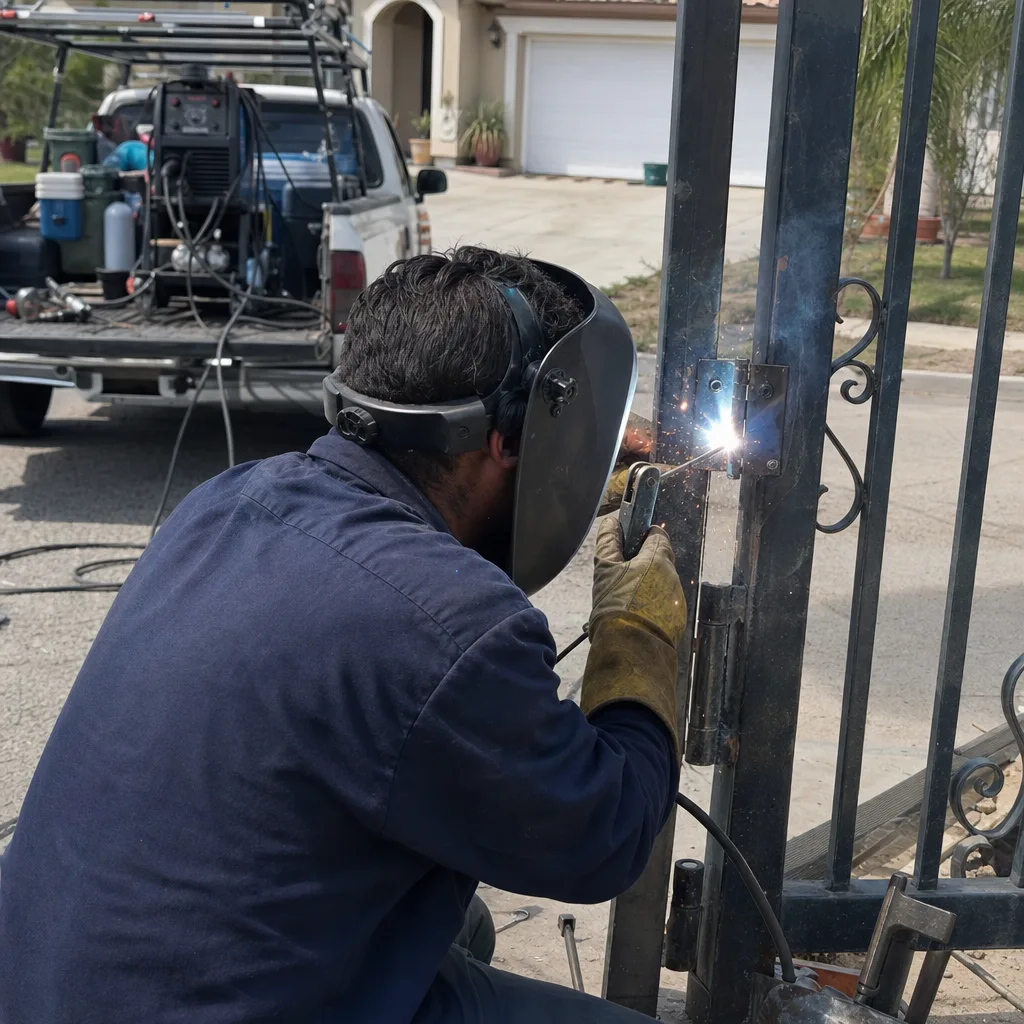
Before you get into measurements and event-specific checks, start with a routine walk-around. This ten-minute visual pass, done every two weeks regardless of weather, catches the majority of developing issues before they become service calls. You don’t need tools for this. You need eyes, a flashlight, and a habit of looking at the same points every time.
- Stand at the gate’s halfway point and sight down the top rail. A properly hung gate reads as a straight line. If it bows downward at the free end, the hinge side is wearing or the post has shifted. If it bows upward, the operator arm may be pushing against a bind.
- Watch one full open-close cycle from the motor side. Listen for any change in pitch. A motor that strains audibly at the same point in the cycle every time is telling you it’s met resistance. Note where in the travel that strain occurs.
- Check the hinge area with a flashlight. Look for rust dust, which appears as reddish-brown or orange powder around hinge pins and bolts. Rust dust means movement between parts that should be statically joined. Tighten, then lubricate, then re-check the following week.
- Look at the gap between the gate and the stop post when closed. If the gap is wider at the bottom than the top, the gate is racking, which usually means a hinge has worn or a weld is failing. Photograph it with your phone. Compare that photo to the one from your last check.
- Check the photo-eye lenses. These are the small round or rectangular optical sensors mounted near the ground on both sides of the gate opening. Wipe them with a dry cloth. In Fontana, dust accumulates on these lenses fast enough to cause false obstruction trips within a month.
- Walk the track on a slide or cantilever gate. Look for debris packed into the rail channel, missing track supports, or visible gaps under the track bed. A five-inch stick caught in a V-track will derail a gate and burn out a motor.
If you do nothing else from this guide, do the ten-minute visual pass every other week. It requires zero mechanical skill, costs nothing, and gives you an early-warning system that would prevent the majority of emergency calls we see across the gate repair jobs we run in Fontana.
What to Check Within 48 Hours After a Santa Ana Wind Event
Santa Ana winds are the single most damaging weather pattern for Fontana gates. They arrive with sustained force, carry abrasive desert fines, and often continue for two or three days, applying cyclic stress that loosens hardware and shifts alignments. Your inspection window is 48 hours after the wind subsides. If you wait a week, the next heat spike bakes the loosened components into a new, worse position.
Post-Wind Inspection Sequence
- Torque-check the hinge bolts. Use a torque wrench rather than a standard socket. Wind applies cyclic loading that backs bolts out in slow increments. If a hinge bolt has rotated even an eighth turn since the last check, re-torque to the manufacturer’s spec and mark the bolt head with a paint pen so future movement is visible at a glance.
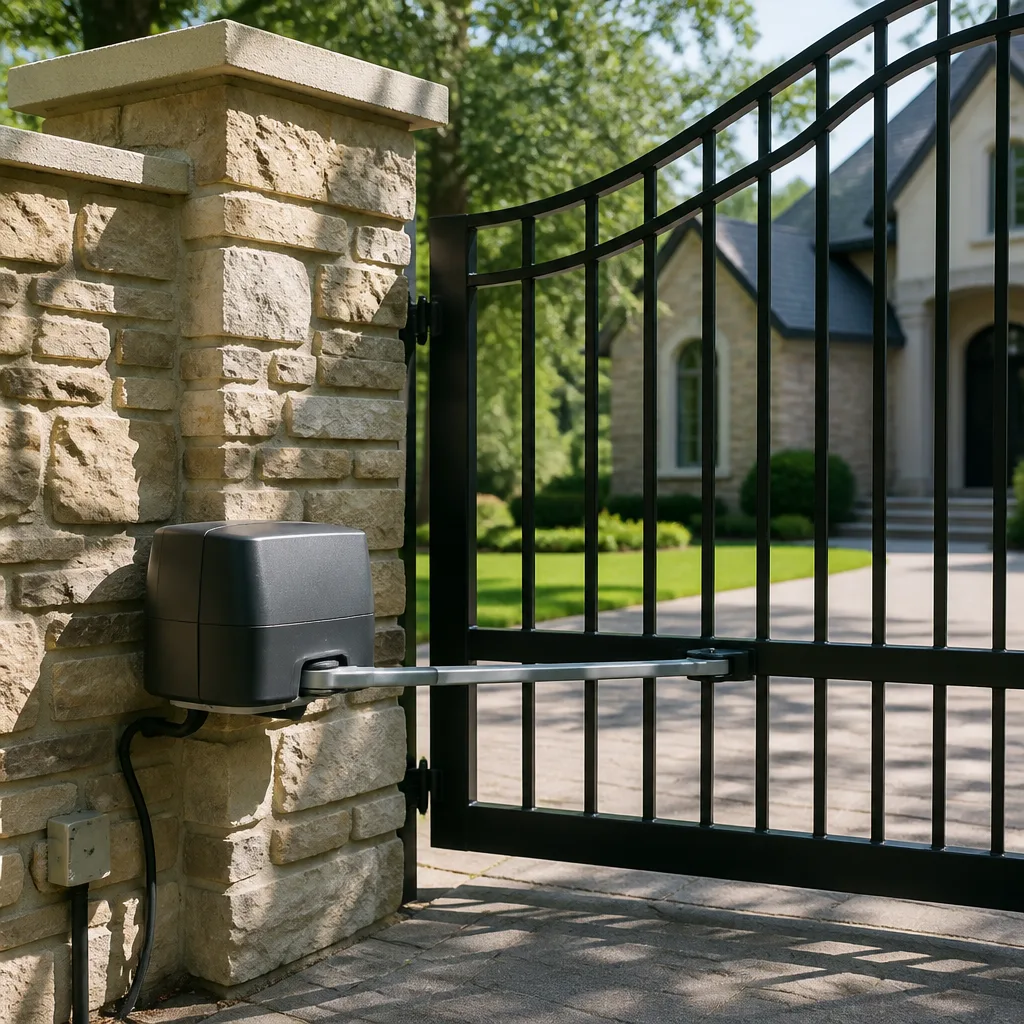
- Check the operator arm bracket. On swing gates, the arm connection at both the gate and the motor post takes direct wind load. Wiggle the arm by hand. There should be no perceptible slop at the pivot pins. If you can feel movement, the bushings or pin have worn, and the arm will transmit more force into the motor with every cycle.
- Verify limit-switch position. Open and close the gate one full cycle. Confirm the gate still stops in exactly the same open and closed positions it did before the wind. Wind gusts that push against the gate while it’s stationary can move the limit-switch cam a few degrees. That drift doesn’t correct itself.
- Inspect the windlocks on chain-driven slide gates. These are the forked brackets that engage a vertical pin to lock the gate in the closed position. Blown sand packs into the engagement surfaces. If the lock no longer seats cleanly, the gate’s primary wind resistance is compromised and the next big gust will slam the full wind load into the motor’s gearbox.
- Clean debris from the gate’s path. Santa Ana winds carry palm fronds, tumbleweeds, and construction debris. A palm frond wedged under a slide gate can add enough resistance to cause a motor overload. Check the full travel path, not just the visible area near the driveway.
One more note: if your gate faced sustained wind pressure for multiple days and now sounds different when it cycles, don’t ignore the change. A new grinding noise after a wind event often signals a gear tooth damaged by wind-induced back-pressure. That’s exactly the kind of finding that’s cheaper to confirm early than to discover as a full motor failure three weeks later during a heat wave.
What to Check After a Hard Rain or Wash-Out
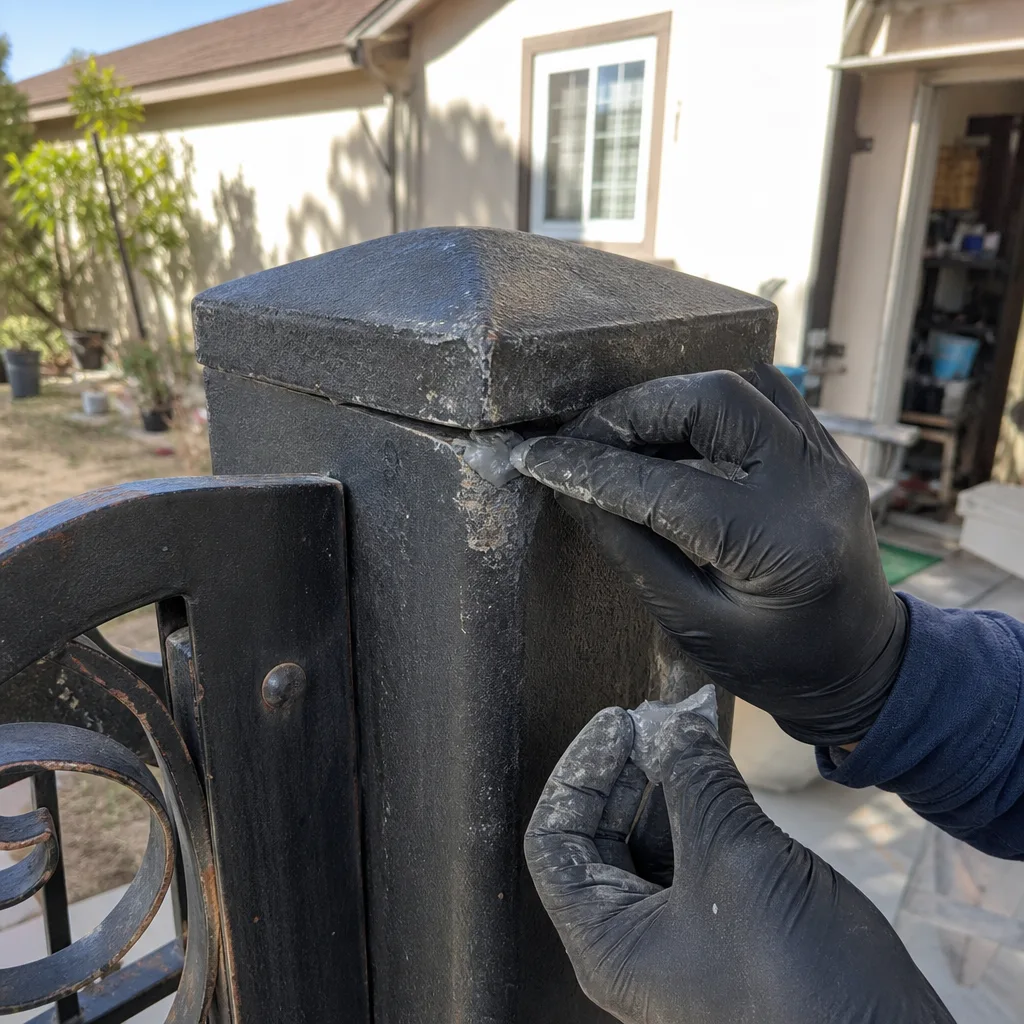
Fontana gets far less rain than most of the country, which means the drainage infrastructure around driveways and gate posts is often designed for rapid surface flow, not absorption. When heavy rain does arrive, water moves fast along hardscape and concentrates at the low points. Gate posts are frequently that low point. The correct post-rain inspection happens once the ground has dried enough to firm up, typically 24 to 72 hours after the last significant rainfall.
Post-Rain Inspection Sequence
- Walk the perimeter of each gate post. Look for a visible gap between the soil and the concrete footing, or between the concrete footing and the post base plate. Erosion around the footing reduces lateral support and lets the post flex under load. A gate post that moves even a quarter inch changes the entire geometry of the gate’s travel arc.
- Check the bottom track clearance on slide gates. Slide gates need a consistent bottom clearance across the full length of travel. After rain, alluvial soil can wash out unevenly and leave sections of the track bed under-supported. Run the gate open, then closed, and watch the bottom of the gate in relation to the track. If the clearance visibly changes, the track bed has shifted.
- Inspect junction boxes and wire entries. Open any junction box along the gate run and look for water entry. Check the seal around the conduit where it enters the box. In Fontana, junction boxes collect fine dust during dry months. That dust becomes conductive mud when water intrudes, which leads to intermittent open and close failures that are notoriously hard to diagnose later. If the box is damp, dry it out and seal the conduit entry.
- Check the control board for moisture indicators. If your operator housing has a clear cover or an interior surface you can safely inspect with power removed, look for condensation staining or white mineral deposits. Both indicate past moisture exposure. Do not open the control board compartment while power is live. If you’re not comfortable with power removal, add this item to your next service call list.
- Verify the auto-reverse and obstruction sensing still work. Place a solid object in the gate’s path mid-travel and confirm the gate reverses on contact or the photo-eye stops it before contact. Water can degrade wiring insulation in the low-voltage safety circuit, causing intermittent failures to reverse. This test takes two minutes and confirms one of the most important safety functions on your gate.
After the inspection, photograph anything that looks wrong. A phone photo with a date stamp is a record you can compare against after the next rain. If the same area worsens between rain events, you have clear evidence of progressive movement and a justification for getting someone out before the gate fails outright.
The Four Baseline Measurements Every Fontana Homeowner Should Record
A measurement only helps you if you have something to compare it to. The first time you do these measurements, you’re establishing a baseline. Every measurement after that is a comparison that tells you whether the gate is stable or degrading. Record all four values in the same notebook or phone note, along with the date and any weather events that happened since the last entry. When a technician arrives, this record is gold. It converts a diagnostic call into a confirmation call, and that’s cheaper and faster for you.
Measurement 1: Hinge Gap
The hinge gap is the space between the gate frame and the post where they meet at the hinge. Measure it with a feeler gauge at the top hinge and the bottom hinge. On a properly installed swing gate, both gaps should be identical and constant through the travel arc. If the top hinge gap grows while the bottom stays tight, the gate is pulling away from the post at the top. If the gap closes down to zero, the gate is cramming into the post and the hinge is binding. Record the measurement in thousandths of an inch. A change of more than 0.020 inches is meaningful.
Measurement 2: Chain Slack
On chain-driven operators, chain slack is the vertical deflection measured at the midpoint of the chain run. Press down on the chain with a ruler and measure how far it moves. Most residential operators specify between 1/4 and 3/8 inch of deflection at the mid-span. In Fontana, chains loosen faster than in temperate climates because heat cycles cause the metal to expand and contract, eventually stretching the chain permanently. Record the measurement at the same point on the chain every time. A continuous increase in slack means the chain is wearing, not just stretching, and replacement becomes the right call before it jumps a sprocket.
Measurement 3: Limit-Switch Position
The limit switch determines where the gate stops in both the open and closed positions. To record its position, mark the gate’s edge where it meets the stop in the closed position with a paint pen, then measure the distance between the mark and the stop when the gate is closed. Do the same at the open position. Record both numbers. Limit-switch drift shows up as a slow change in these numbers. On gates with mechanical limit switches, drift of more than 1/2 inch means the switch’s contact surface is wearing or the cam is slipping. On magnetic limit switches, drift usually means the sensor mount has moved.
Measurement 4: Battery Voltage
Battery-backup systems and solar-powered gates rely on batteries that degrade in Fontana’s heat. Heat shortens battery life faster than cold does, and a battery that’s marginal in September will be dead by February. Measure the battery’s resting voltage with a multimeter with the charger unplugged. A fully charged 12V sealed lead-acid battery reads 12.6 to 12.8 volts at rest. A reading below 12.4 volts at rest means capacity has started to degrade. Record the voltage, the battery type, and the date. If the voltage drops a tenth of a volt between inspections, replace the battery before you get stuck outside with a dead operator.
These four numbers, recorded twice a year and after any major weather event, give you a maintenance record that most Fontana homeowners don’t have. When you call someone for gate motor or opener service, you can tell them exactly which measurement changed and by how much. That cuts diagnostic time and gets the repair moving faster.
Lubrication in Fontana’s Dry, Dusty Climate: Type, Interval, and Method
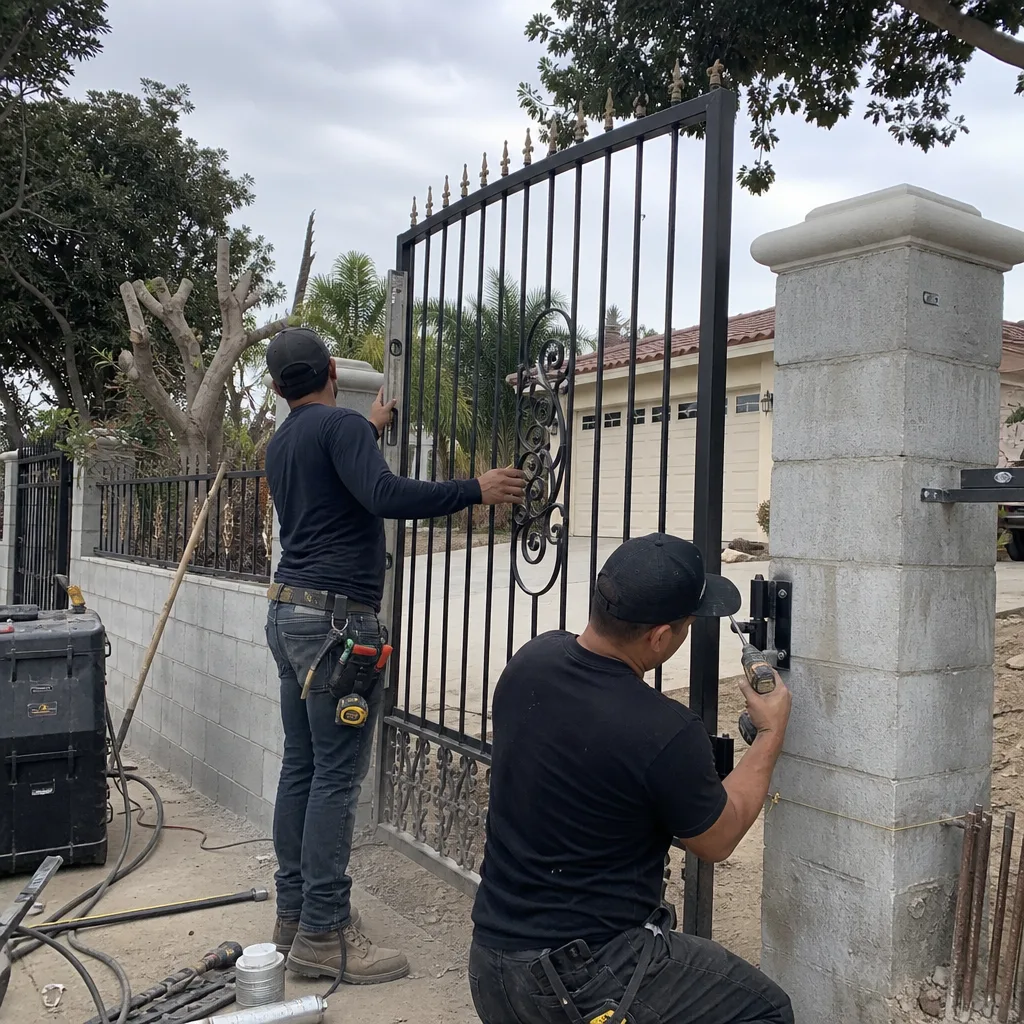
Operator manuals are written for general conditions, and most specify a light machine oil or white lithium grease on hinges, rollers, and chains. That guidance works in moderate climates. In Fontana, it creates problems. Light oils evaporate under sustained heat. White lithium grease collects airborne dust and sand, turning into an abrasive paste that accelerates wear instead of preventing it.
The right lubrication for Fontana’s environment is a dry-film lubricant with PTFE or a heavy-grade silicone paste for pivot joints, and a purpose-made chain lube for chain drives. Dry-film lubricants suspend the lubricant in a solvent carrier that flashes off, leaving a thin protective layer that doesn’t attract grit. Heavy silicone paste stays put on pivot points and won’t run out when the gate frame hits 130°F in direct summer sun. Chain lube is engineered to cling to moving chain surfaces and resist fling-off, which matters when the chain is exposed to dust.
What to Lubricate and When
- Hinge pins and pivot points: Every 90 days, or after any Santa Ana event that left visible dust accumulation. Clean the pin with a dry rag first, then apply a thin bead of heavy silicone paste. Wipe away the excess. Leaving a thick layer invites dust to pack in.
- Chain drives (if equipped): Every 60 days during summer, every 90 days in winter. Apply chain lube to the inside of the chain run while the gate is stationary, then cycle the gate once to distribute. Wipe excess from the outside of the chain to reduce dust pickup.
- V-wheel axles on slide gates: Every 90 days. Apply a small amount of dry-film lubricant to the axle bearing area, not the wheel face. Lubricant on the wheel face reduces traction and causes the gate to slip rather than track.
- Track rail surfaces: Do not lubricate the rail. Slide gate wheels rely on friction against the rail to move the gate. Lubricating the rail allows wheel slip, which causes the gate to stall and the motor to overload. If the rail is squeaking, clean it instead of greasing it.
- Limit switch mechanical contacts: These should remain dry. If a limit switch is sticking, clean it with contact cleaner and leave it dry. Lubricant here collects dust and eventually causes the switch to fail to engage reliably.
Over-lubrication is more common than under-lubrication in Fontana. We regularly see hinge assemblies so packed with old grease that the only way to restore proper movement is to disassemble, clean, and start fresh. A thin, consistent film is the goal. If you can see the lubricant, there’s probably too much of it.
The Maintenance Log: What to Hand a Technician When They Arrive
The single most valuable thing you can hand a gate technician is a written history of your observations and measurements. Most our Gate Repair services calls start with the technician asking the homeowner what happened, when it happened, and what the gate sounded like. Most homeowners answer from memory, and memory is unreliable under the stress of a failing gate. A maintenance log eliminates that entire phase of the service call.
Your log doesn’t need to be formal. A spiral notebook, a notes app, or a printed sheet inside the operator housing all work. What matters is the content:
- Date and time of every observation, including weather conditions if relevant
- The four baseline measurements from the previous section, updated each time you take them
- Any change in sound, vibration, or speed observed during normal operation
- Any interruption in operation, even if the gate recovered on its own. Intermittent failures are often the first sign of a failing capacitor, relay, or solder joint.
- Lubrication dates and products used, so the technician knows what’s on the components and can tell you if it’s the right product
- Photos of anything that looked wrong, dated and annotated
When you hand this to a competent technician, the diagnostic process becomes confirmation rather than investigation. The technician checks the exact things your log points to, verifies the readings against their instruments, and confirms the diagnosis. A service call that might take an hour of discovery gets cut to twenty minutes of confirmation. That’s not just convenient, it’s a real cost reduction on hourly diagnostic labor.
We encourage every client to keep a log because it aligns with how we already work. Under the Haven Standard, every visit from Vance Gate Repair includes a photo and written record of what was found, what was adjusted, and what was installed. Your maintenance log and our service record combine into a complete history of the gate that follows the property, not just the service date. When the gate eventually fails, that combined history means no one pays to rediscover a problem that was already identified and documented. If you’re considering a full gate installation in Fontana, the documentation habit you build now transfers directly to the new gate’s service life.
Common Mistakes to Avoid

- Lubricating the track rail. We see this constantly. Homeowners hear a squeak, grab general-purpose grease, and apply it to the rail surface. The gate then slips under load and the motor works harder to move it. Clean the rail; don’t grease it. The squeak usually comes from the wheel axles, not the rail face.
- Ignoring intermittent failures. A gate that fails to open once a week and works fine the other 51 times is already failing. Intermittent operation often precedes a complete failure by weeks or months. Record it in your log with the date and conditions, and if it happens twice in a month, make the call.
- Pressure-washing the gate and operator housing. Pressure washers force water into hinge pins, limit switches, and control board enclosures. Fontana’s dry air makes gates less prone to corrosion, which means the risk of pressure-wash water damage is proportionally higher. Wash by hand with a garden hose and a car-wash brush instead.
- Using tire inflators or general-purpose spray lubes on hinges. These products are engineered for intermittent, low-load use. They evaporate or wash out of gate hinges within weeks and leave no protection. Use a product designed for sustained load and environmental exposure.
- Waiting for the scheduled service date when something changed noticeably. The whole point of event-triggered maintenance is to catch problems when they’re small. If your gate sounds different, stops in a slightly different position, or needs a second button press to start, don’t wait for the next calendar inspection. That’s the gate telling you something moved.
- Failing to photograph what you find. A written note that says “gap looks bigger” is hard to act on. A photo next to a ruler or coin for scale tells the technician exactly what they’re looking at. Your phone camera is a precision documentation tool. Use it on every inspection.
When to Call a Professional
Some gate problems are simple to spot and simple to confirm with the maintenance log. Others need an experienced hand, and knowing the difference saves you from either ignoring a real problem or wrestling with a repair that’s beyond safe DIY scope. Call a professional when your measurements show continuous drift in the baseline numbers, when the gate has become noticeably louder or rougher over two or more consecutive inspections, or when the gate has failed to operate on more than one occasion. Also call if you find any cracking in the gate frame, hinge welds, or operator bracket, or if your post-rain inspection shows soil erosion around a post that’s more than a few inches deep. If you’re not comfortable working with the operator’s control board or high-tension components, leave those alone and call someone who is. Vance Gate Repair Fontana offers free estimates in Fontana. Call (951) 476-1539 and we’ll send a technician who can confirm what your log is telling you and give you a written price before any work starts.
Frequently Asked Questions
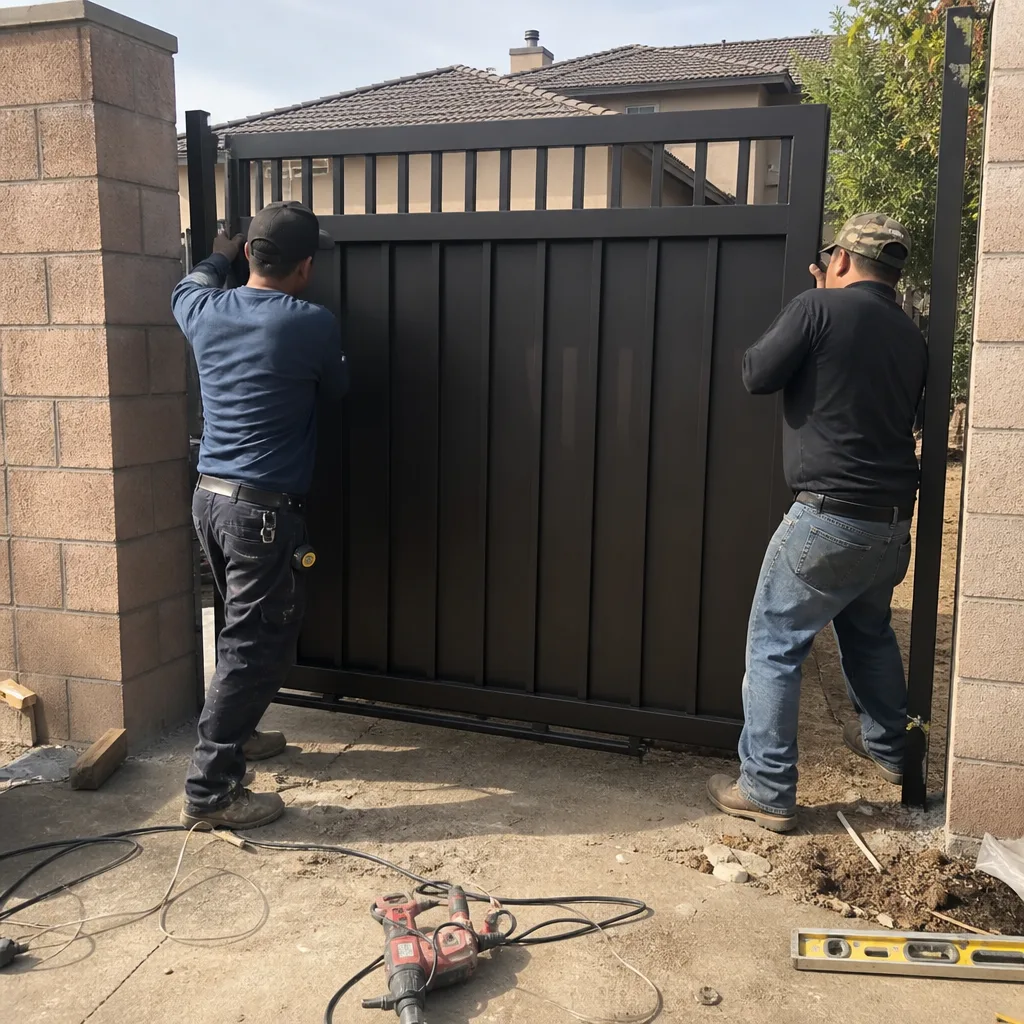
Visually inspect your gate every two weeks and perform a deeper inspection, including the four baseline measurements, within 48 hours after every Santa Ana wind event and after any significant rainfall. Fontana’s climate creates wear on an event basis, not a calendar basis, so inspection frequency should follow the weather, not the months.
Use a dry-film PTFE lubricant or a heavy-grade silicone paste on pivot points and hinges, and a purpose-made chain lube on chain drives. Avoid general-purpose spray lubes and white lithium grease, which collect Fontana’s airborne dust and create an abrasive paste that accelerates wear on moving parts.
Hinge bolt inspection and torque verification are reasonable DIY tasks if you have a torque wrench and follow the manufacturer’s spec. But if the hinge itself is worn, if the post has shifted, or if the gate weighs more than you can safely support while the hinge is apart, call a professional. A gate that comes off its hinges under load is a serious safety hazard, and hinge replacement on a heavy gate is not a beginner repair.
Most minor gate repairs in Fontana, such as limit-switch reset, photo-eye realignment, or hinge bolt re-torque, range from $120 to $350. Motor replacements typically run $600 to $1,600 depending on the brand and whether the existing mounting hardware is reusable. Full hinge replacement on a heavy swing gate runs $400 to $900 per hinge including labor, depending on the gate’s weight and the extent of any post repair needed. Call (951) 476-1539 for an exact quote. Estimates are free and the price is provided in writing before any work starts.
The most common cause is limit-switch drift. Santa Ana wind gusts push against the gate while it’s stationary and can rotate a mechanical limit-switch cam a few degrees, changing the point where the operator thinks the travel should stop. The fix is normally a limit-switch reset and re-torque of the holding screws. It’s a quick repair, but if it recurs after the next wind event, the switch itself is worn and should be replaced. Call (951) 476-1539 and we’ll confirm it on site.
Yes. We service all four of those brands plus five others, covering nine major gate automation manufacturers in total. If your gate already has a Viking, Ghost Controls, DoorKing, or Elite operator on it, we’ll repair what’s there rather than steering you toward a replacement motor unless the existing unit is genuinely beyond service. Bring us your maintenance log and we’ll start from your measurements, not from zero.
The Bottom Line
This checklist works because it matches the way gates actually wear in Fontana. Inspect after wind events and heavy rain, keep the four baseline measurements, use lubricants that don’t collect desert dust, and write everything down. Ten minutes every other week and a habit of recording what you find will prevent most emergency gate failures before they happen. When something does need attention, you’ll have the documentation to make the service call fast and precise, as outlined in Gate Repair Permits, Codes & Inspections in CA: What You Need to Know. And if you decide you’d rather have someone else do the watching, Vance Gate Repair Fontana will give you a written price before we touch a tool and leave you a photograph record of what we found and what we did. Call (951) 476-1539 for a free estimate.
Written by Adrian Vance, Owner at Vance Gate Repair Fontana, serving Fontana since 2014.