
Last updated September 20, 2026
Free on-site gate assessment - hinges, posts, and your LiftMaster or Nice gate operator checked before anything is quoted
The assessment is free and the quote is the invoice.
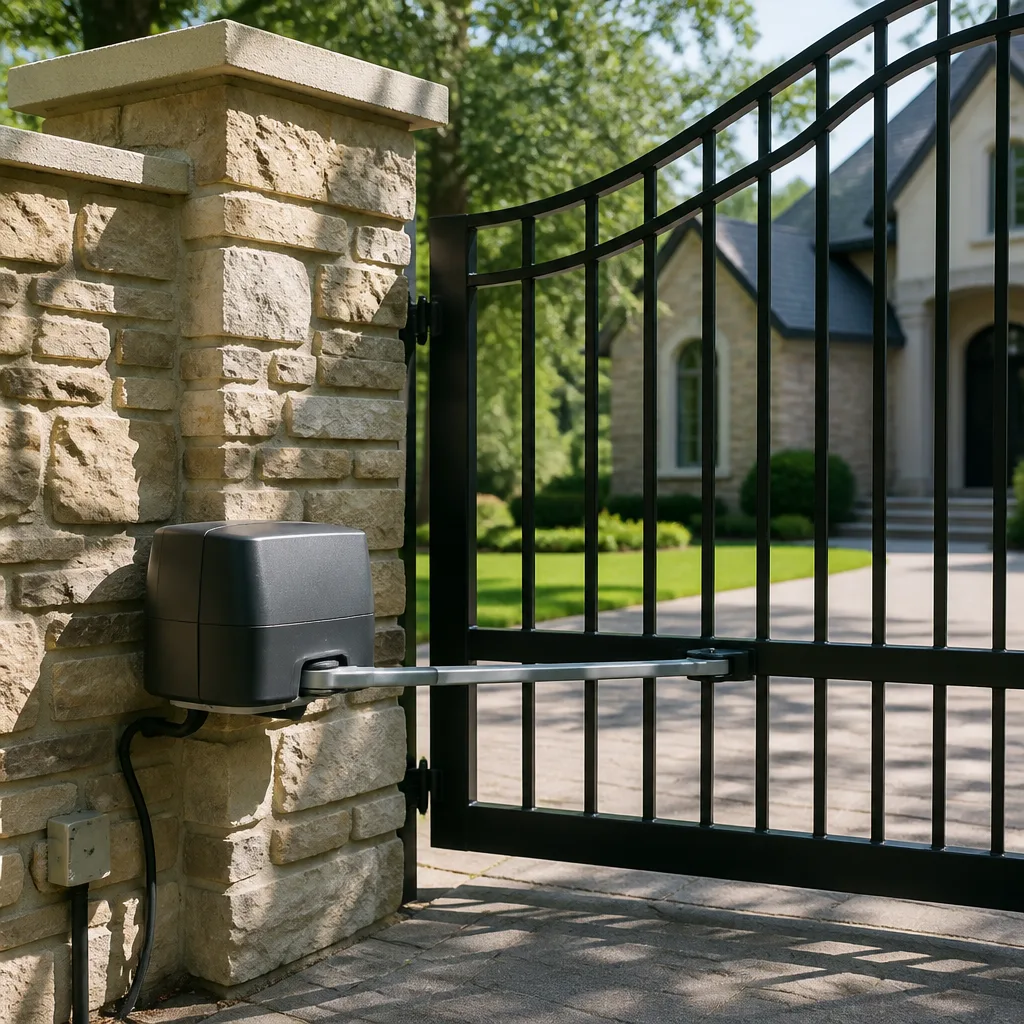
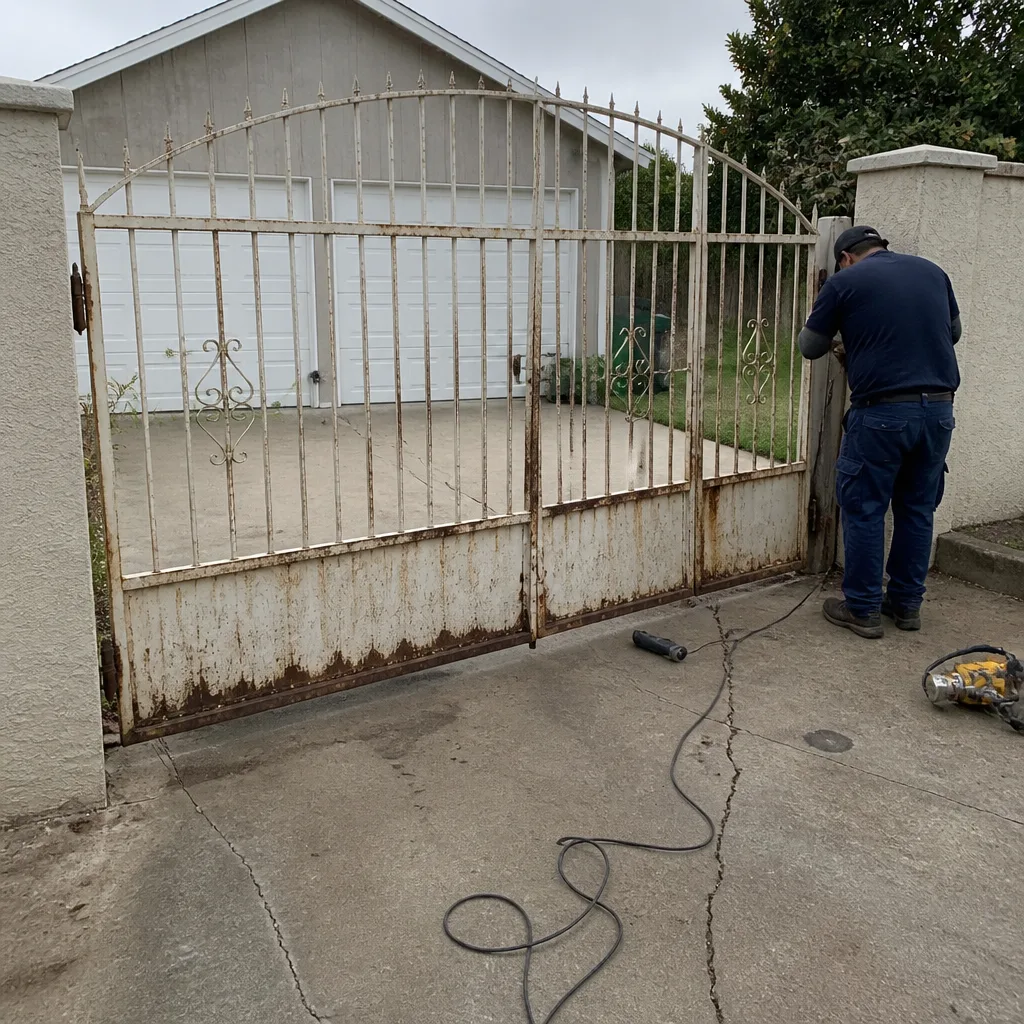 Before
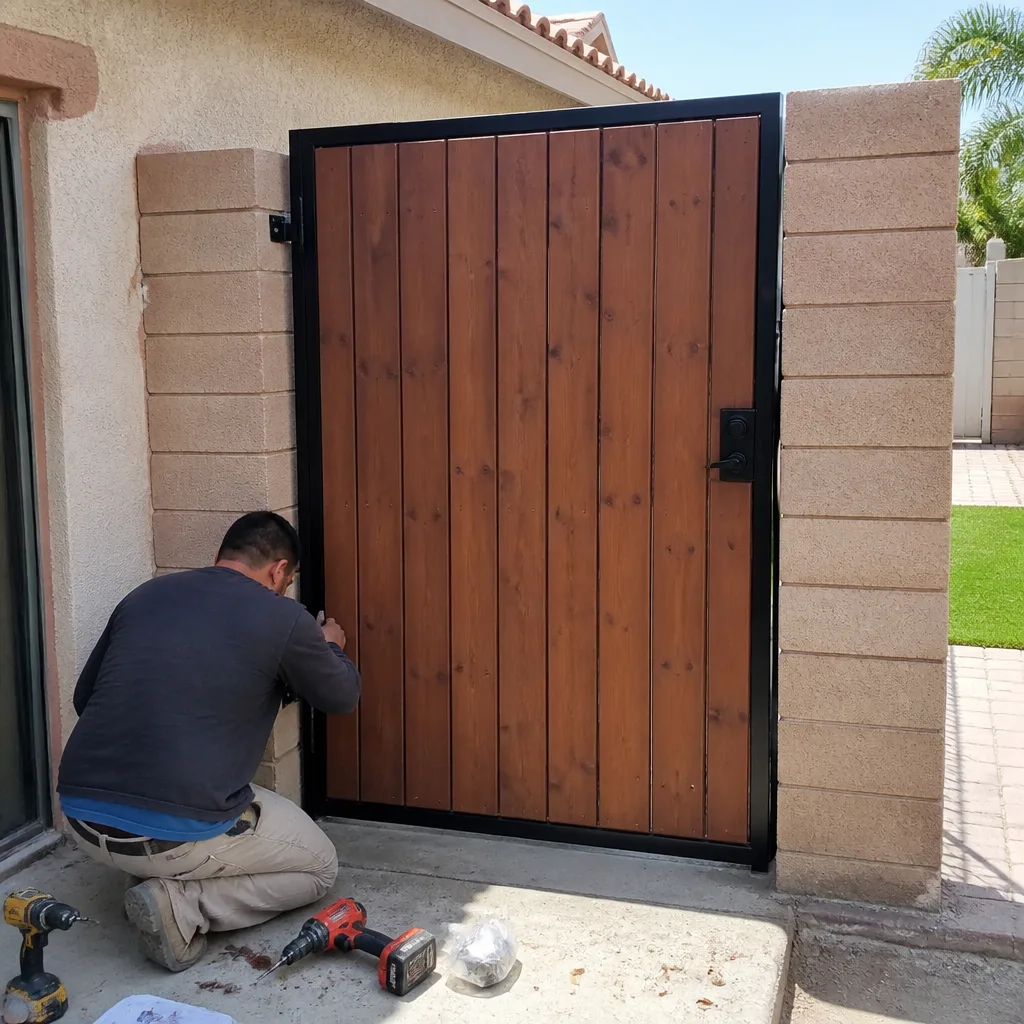 After
After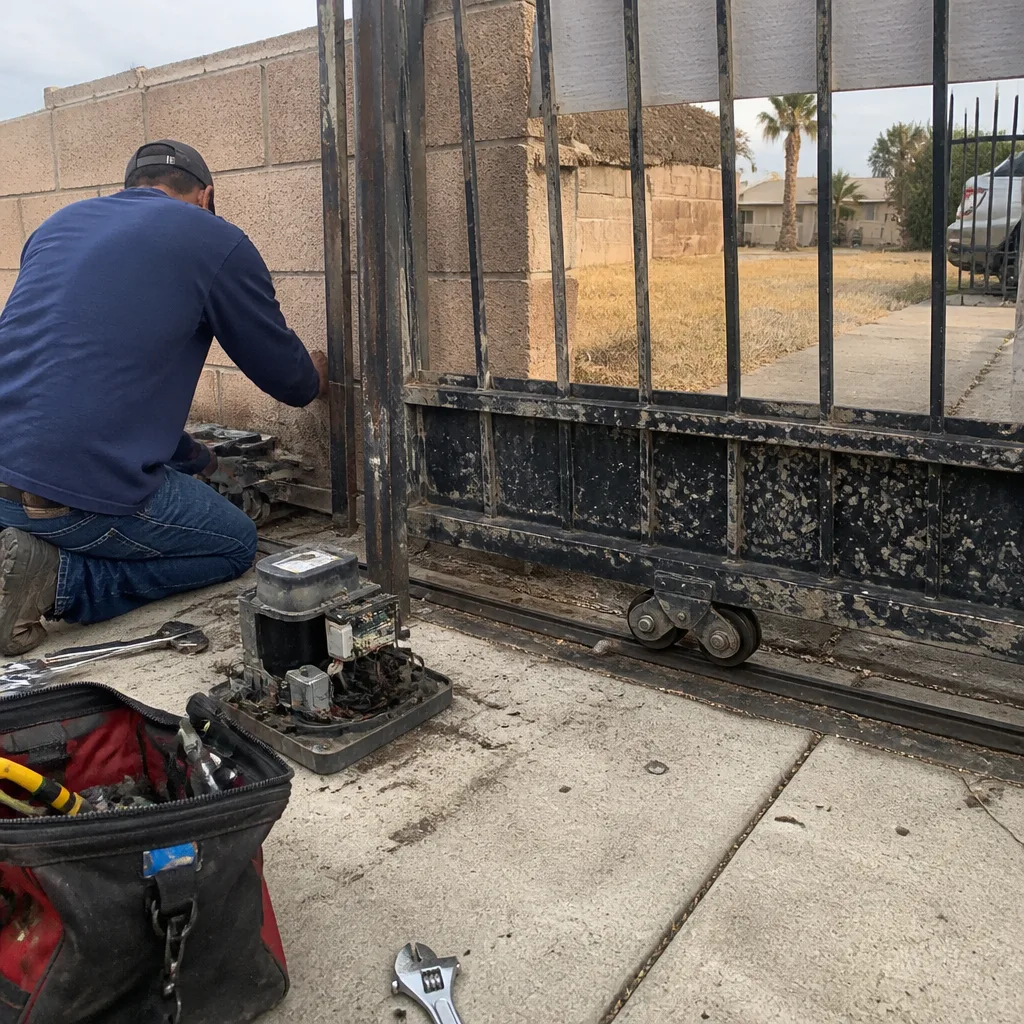 Before
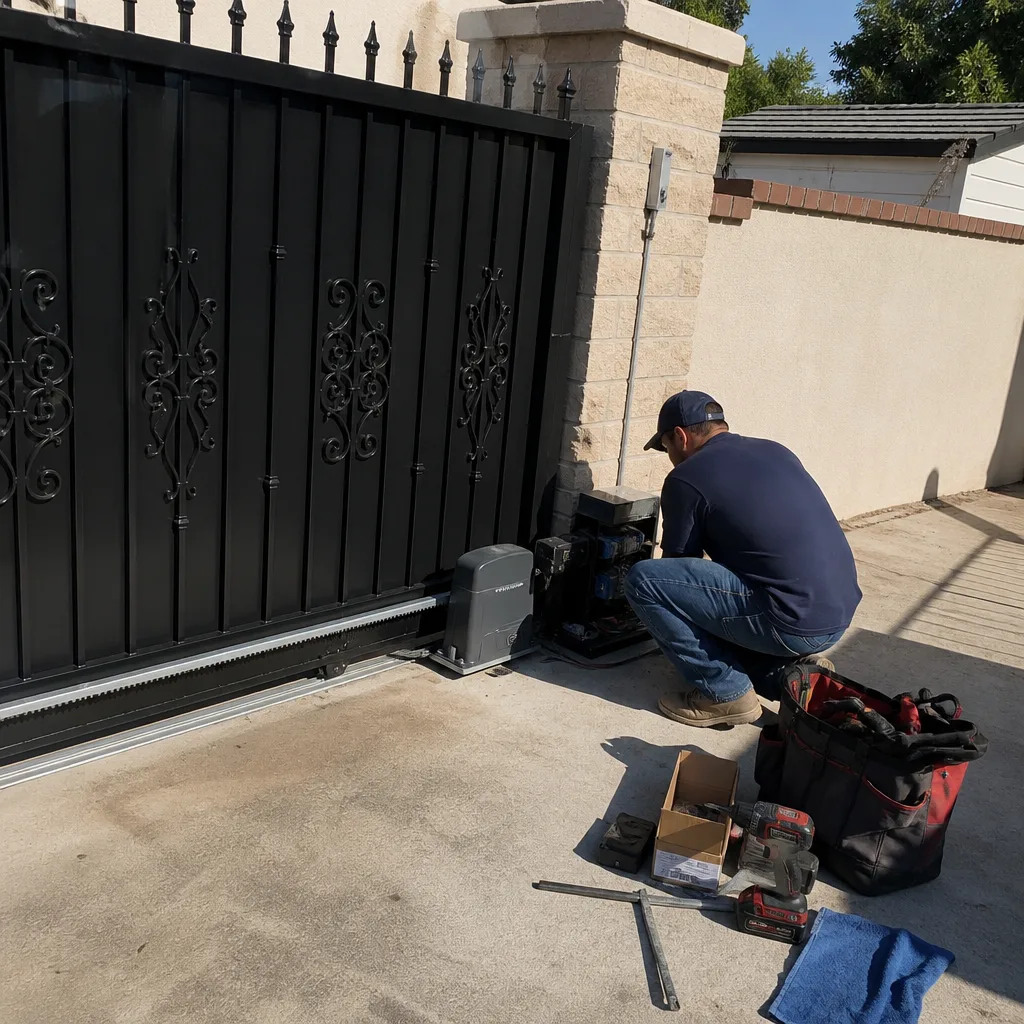 After
After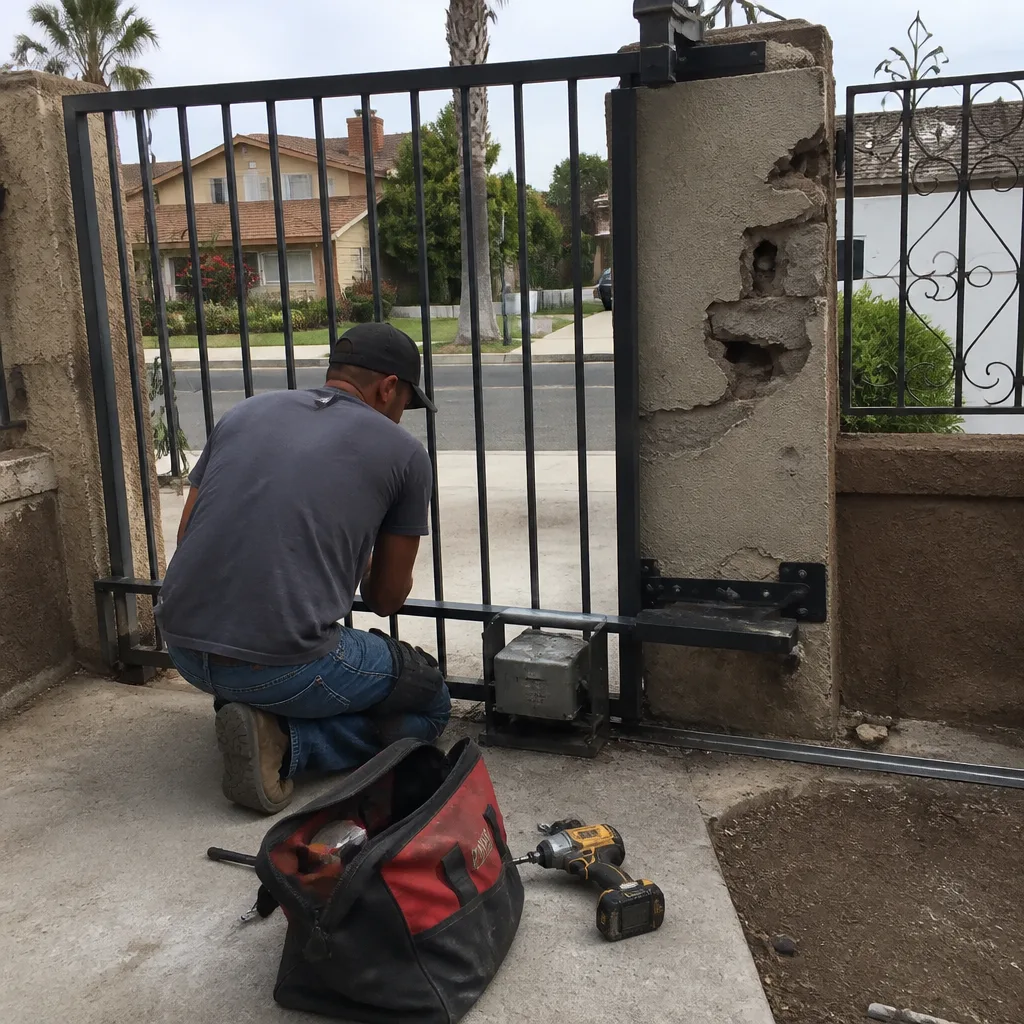 Before
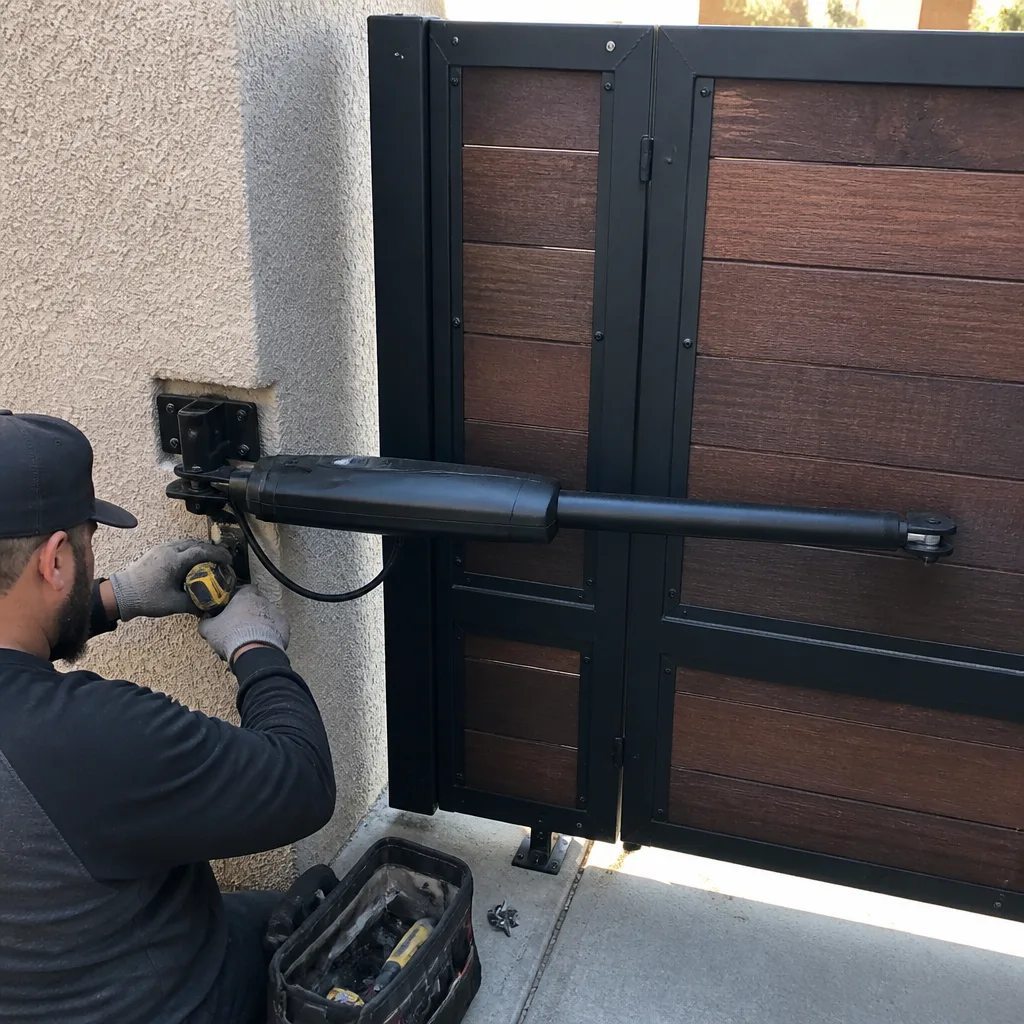 After
AfterThe Complete Guide to Gate Repair in Fontana
Most gate failures in Fontana are not random. They follow a pattern, and the pattern is written into the geography. Dust from the Santa Ana winds works its way into limit switches and gearboxes. Summer temperatures that sit above 105°F for weeks at a stretch bake electrolytic capacitors until they bulge and quit. Caliche soil, the rock-hard calcium carbonate layer that runs through much of San Bernardino County, shifts posts just enough to throw a gate out of alignment so it binds against its own hinges. A gate that opens smoothly in January will drag, stall, or reverse itself by August. This guide maps Fontana’s specific failure patterns to the components that actually break, in the order they typically break, so you know what you are looking at before you spend a dollar. Browse more guides & resources for related maintenance topics.
Quick Answer
Gate repair in Fontana typically costs between $180 and $450 for common fixes like limit switch resets, photo-eye realignment, and hinge replacement, while full motor replacements usually run $700 to $1,800 depending on the brand and arm configuration. See our Gate Repair Cost Breakdown: The Fontana Homeowner’s Reference for 2026 for detailed line items. Most swing-gate mechanical repairs can be completed the same day by a qualified technician. The single best protection against repeat failures is a written scope and a documented photo record of every adjustment, so no future repair starts from scratch.
Table of Contents
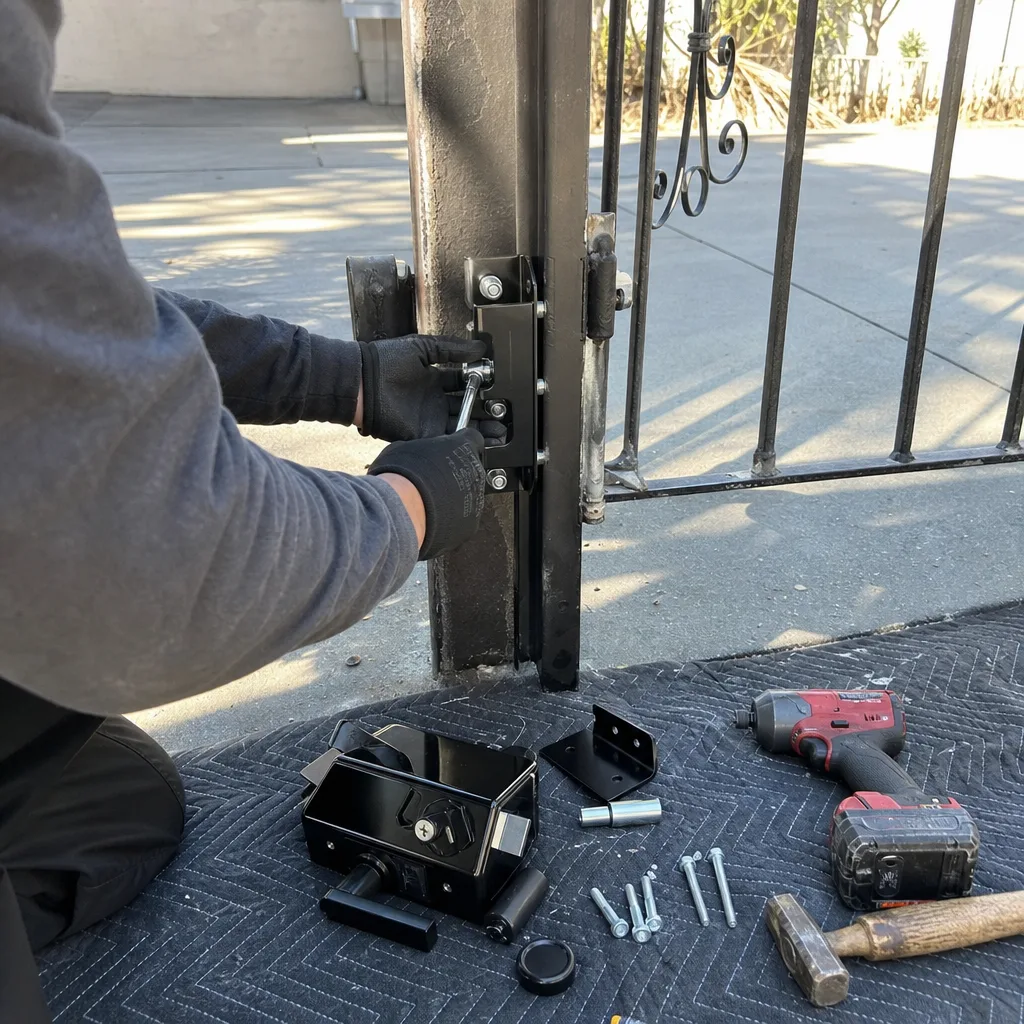
- Fontana-Specific Gate Failure Patterns
- The Order Components Actually Break
- Swing, Slide, and Bi-Fold Gates on Large Fontana Parcels
- Heat, Capacitors, and Circuit Boards: What 105°F Does to a Gate Motor
- Caliche Soil, Post Lean, and Structural Misalignment
- How to Read a Written Scope Before Work Begins
- What a Complete Post-Repair Documentation Package Contains
- Common Mistakes to Avoid
- When to Call a Professional
- Frequently Asked Questions
BeforeAfterFontana-Specific Gate Failure Patterns
Coastal gate companies write their service intervals for coastal weather. A manufacturer in Ohio or a distributor in Los Angeles assumes a motor will see moderate temperatures, occasional rain, and soil that behaves. Fontana violates all three assumptions. The inland heat here is not a hot day; it is a sustained thermal load of 100°F to 110°F that sits on a metal control box for four to six hours daily from June through September. That heat does two things. First, it degrades electrolytic capacitors, the cylindrical components inside the control board that smooth voltage and store the burst of current needed to start the motor. A capacitor rated for 10,000 hours at 85°F may last 4,000 hours at 105°F. Second, heat expands the metal in the gate leaf, the post, and the hinge pin at different rates, because steel and aluminum have different thermal expansion coefficients. A gate that clears its latch by half an inch in January can bind against it in August simply because the metal grew.
Dust compounds the problem. The Santa Ana winds and ordinary Fontana afternoon breezes carry fine particulate that gets into the motor housing, the limit switch contacts, and the gear reduction. We have opened motors in Fontana where the factory grease inside the gearbox had become a gray paste, more abrasive than lubricating, after three summers of dust ingestion. None of this shows up in a coastal service manual. It shows up only when a technician has worked enough inland jobs to recognize the pattern.
The Order Components Actually Break
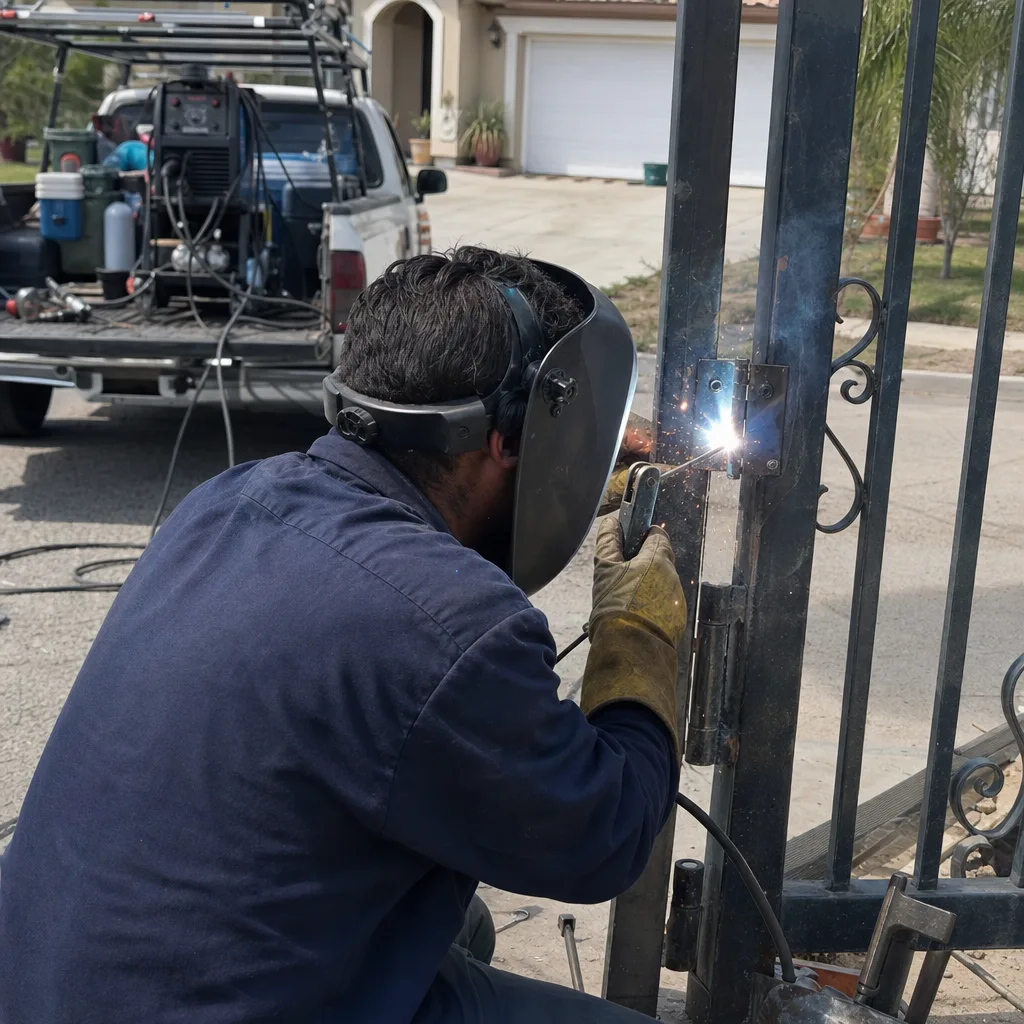
Gate systems fail in a predictable sequence. Understanding this sequence saves money, because the first symptom is rarely the root cause. Here is the sequence we see across Fontana, North Fontana, Southridge, and the larger parcels along Sierra Lakes and Hunter’s Ridge.
- Photo-eye misalignment. The infrared beam that tells the gate to stop if a car or child crosses the path gets bumped, dusted over, or shifted by heat expansion of its mounting bracket. This is the number one service call in Fontana. The gate reverses or refuses to close, and the homeowner assumes the motor is dying. Most of the time, it is a two-inch misalignment on a $60 part.
- Limit switch drift. The limit switch tells the motor where to stop opening and where to stop closing. Heat cycles and vibration cause the set screw to walk. The gate opens too far and slams the stop, or closes short and leaves a gap. Over time the repeated impact stresses the gear train.
- Hinge and wheel wear. A steel gate leaf is heavy. On swing gates, the hinge pins wear ovals into the hinge barrels. On slide gates, the steel guide wheels wear flat on one side. You hear a grinding or see the gate sag. This is mechanical wear, not electrical failure, and it is the most neglected repair because it happens slowly.
- Capacitor failure. The motor hums but does not start, or starts slowly and trips the overload. In Fontana, capacitors fail earlier than anywhere along the coast. A technician who has not worked inland may misdiagnose this as a dead motor and sell a $1,200 replacement when a $40 capacitor fixes it. We replace capacitors on motors that are otherwise healthy every week in the summer.
- Circuit board failure. Heat, power surges from summer grid stress, and dust accumulation on the board eventually kill the logic controller. This is the most expensive electronic repair and the most misquoted, because a board that fails intermittently looks like a dozen smaller problems before it fails permanently.
- Gear and motor failure. The last thing to go is usually the motor itself, or the reduction gear inside it. By the time a motor dies, the gate has usually been telling you about the problem through every one of the failures above for months or years.
None of this requires a full system replacement. The Gate Repair in Fontana page walks through our diagnostic process step by step. Our technicians, led by Adrian Vance, are trained to fix the failed component and document everything else they inspected, so you do not pay for a motor when a capacitor would do.
Swing, Slide, and Bi-Fold Gates on Large Fontana Parcels
Fontana’s large-lot residential parcels, particularly in the north end of the city and up toward Lytle Creek Road, favor gate types that coastal homes rarely use. Each has a distinct failure profile.
Swing Gates
The most common residential gate in Fontana. A swing gate is a leaf on hinges, driven by an arm operator or an underground operator. The failure modes are hinge wear, post lean from caliche soil movement, and arm bracket fatigue. On long double-leaf swing gates, the second leaf often lags because the slave leaf relies on a mechanical or electrical link that drifts. Symptom: one leaf closes first, then the other catches up or does not close at all.
Slide Gates
More common on Fontana parcels with long driveway runs and limited setback. A slide gate rides on steel wheels along a track. The failure modes are wheel wear, track debris accumulation (dust and gravel in Fontana are constant), and rack-and-pinion gear wear. A cantilever slide gate, which floats over the opening without a track, eventually develops carrier truck bearing wear. Symptom: the gate jerks, shudders, or moves slower than it did a year ago.
Bi-Fold Gates
Fast and compact, used where a full swing radius will not fit. Bi-fold gates fold in the middle as they open. Their failure mode is almost always in the hinge set and the folding mechanism alignment, not the motor. A bi-fold gate that binds mid-travel is a mechanical alignment problem more often than an electrical one.
If you are replacing rather than repairing, the Gate Installation in Fontana page covers what a properly specified new gate should include, from post depth below the caliche layer to operator sizing for the gate’s weight and cycle frequency.
Heat, Capacitors, and Circuit Boards: What 105°F Does to a Gate Motor
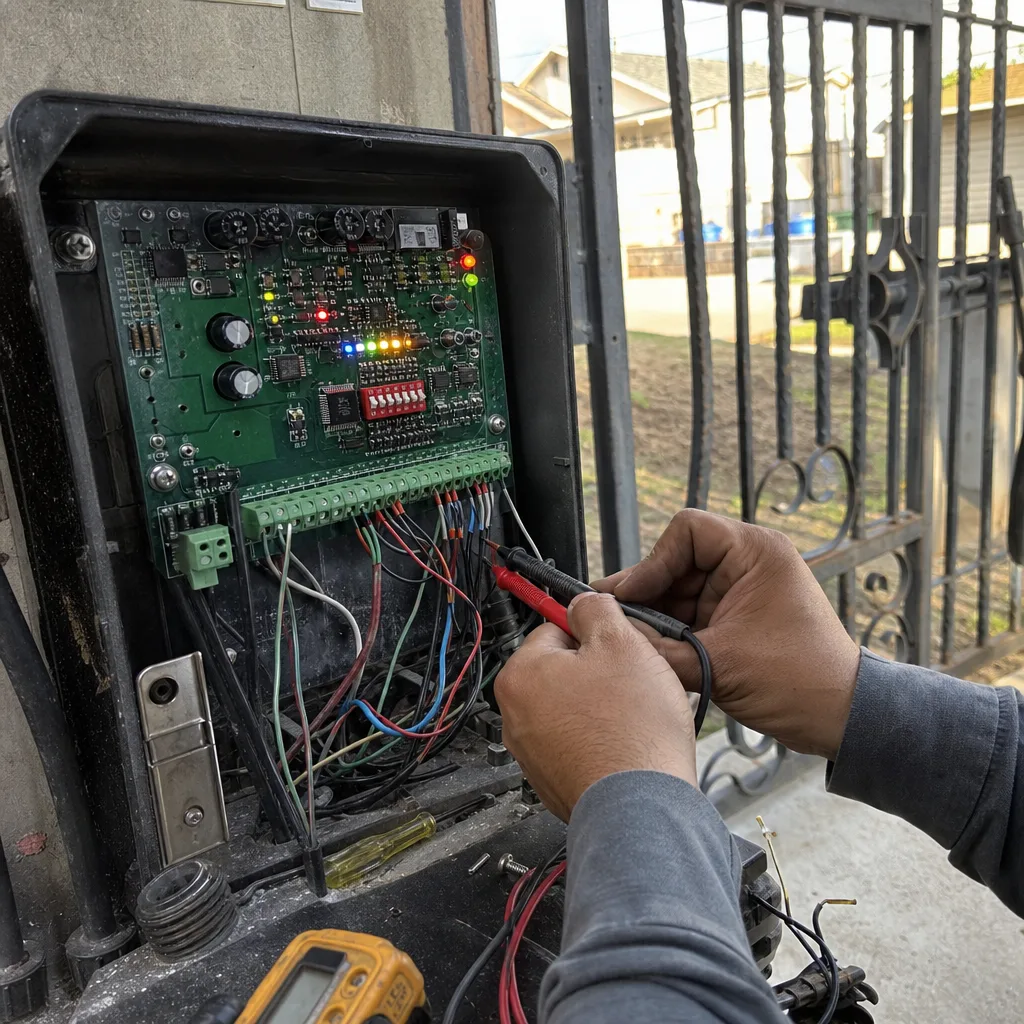
Manufacturer replacement intervals assume the control board lives inside a shaded enclosure with adequate ventilation. In Fontana, control boxes mounted on west-facing walls or sitting in direct afternoon sun reach internal temperatures far above ambient. A dark gray control box in full sun on a 108°F day can hit 140°F inside. That is not speculation; we have measured it with an infrared thermometer while diagnosing intermittent failures in North Fontana.
Electrolytic capacitors contain a liquid electrolyte. Heat accelerates evaporation of that electrolyte. As the capacitor dries out, its capacitance drops and its equivalent series resistance rises. The motor draws more current at startup, which stresses the transformer and the relay. Eventually the motor hums without turning, or the board resets randomly in the middle of a cycle. Homeowners describe this as “the gate has a mind of its own.” What the gate has is a dying capacitor that a $40 part and thirty minutes of labor would fix.
Circuit boards fail from the same heat in more complicated ways. Thermal cycling, the repeated expansion and contraction of the board and its solder joints, eventually cracks solder connections. A hairline crack in a solder joint conducts fine when the board is cold and opens when the board heats up. That is why a board that works in the morning fails in the late afternoon in Fontana. It is also why a technician who only visits in the morning can misdiagnose an intermittent board as a good board. The fix is proper diagnosis under load, not a guess.
The Gate Motor & Opener in Fontana page details how we test motors and boards before recommending replacement, including what a capacitor test under load looks like.
Caliche Soil, Post Lean, and Structural Misalignment
Caliche is a layer of calcium carbonate that forms a rock-like hardpan beneath the topsoil in much of San Bernardino County, including Fontana. It is not uniform. Some posts hit it at eighteen inches; some hit it at thirty. What matters for gate repair is what happens above the caliche layer during wet winters and dry summers. The topsoil expands when it gets rain and contracts when it dries out, while the caliche below stays solid. A post set in the topsoil layer, above or partly into the caliche, will work loose over enough seasons. The post tilts, the gate sags, and the hinges bind.
The symptom looks electrical. The gate strains, reverses, or trips its obstruction sensor. The homeowner calls for motor service. The actual problem is structural: the post has moved and the gate leaf is no longer hanging true. In our experience in Fontana, roughly a quarter of what presents as a motor or sensor problem is post movement underneath it. The fix is post remediation, not a new motor. A technician who only checks the electronics will replace a good board and leave the post still leaning.
You can check this yourself before calling. Stand at the side of the gate and sight down the hinge edge. If the post is plumb but the gate leaf drifts inward or outward, the hinges are worn. If the post itself is out of plumb, the problem is structural. Either way, get it fixed before the misalignment chews through the gear train.
How to Read a Written Scope Before Work Begins
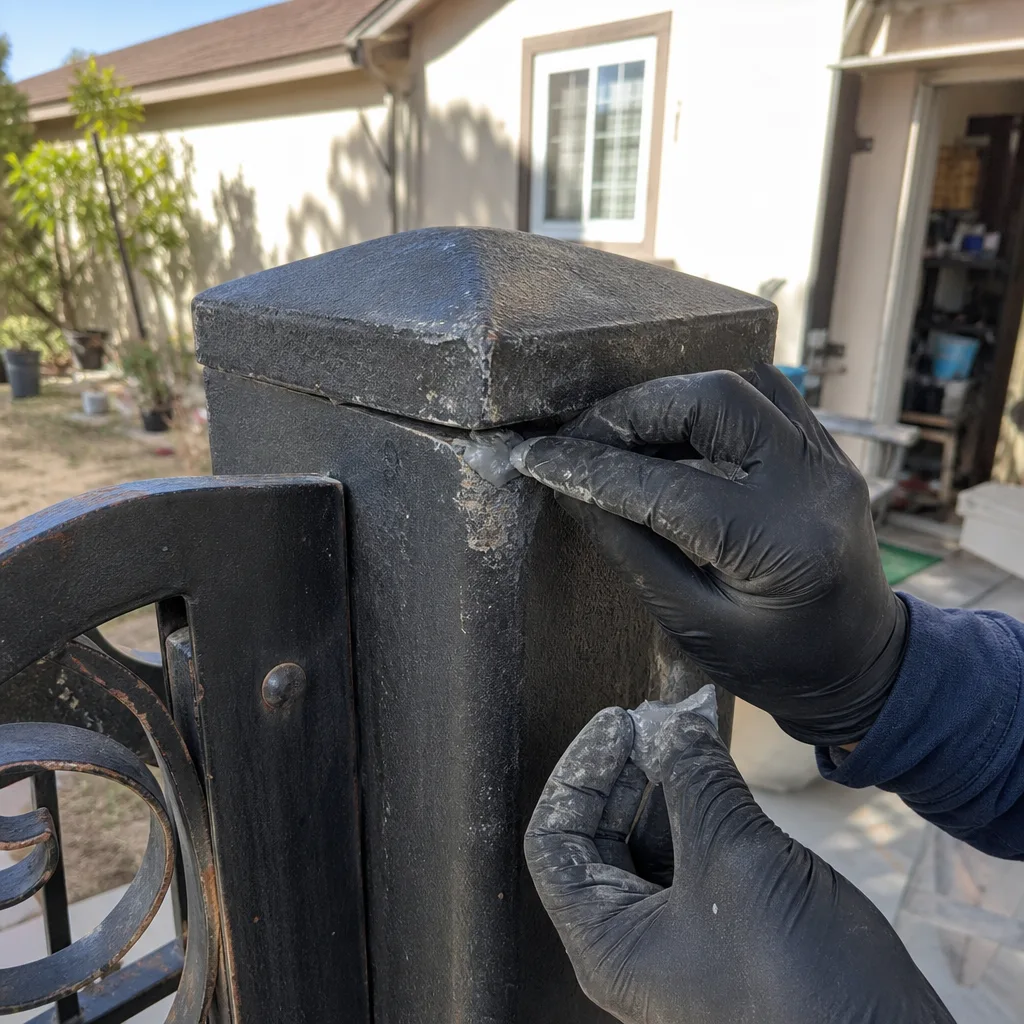
Most gate repair quotes are verbal, and that is where homeowners lose money. A verbal quote describes intent. A written scope describes work. Here is how to read one before you approve any repair.
- Look for a part number or a specific component, not a category. “Replace motor” is a category. “Replace FAAC 402 CBC control board, part number 790322, with new OEM unit” is a scope. If the scope does not name the part, ask for the part number before work starts.
- Look for a discrete labor line. A written scope that says “$900, includes parts and labor” tells you nothing about what the technician will actually do. A scope that says “Remove old board, install new board, verify limit switch travel, test full open/close cycle five times, photograph final settings” tells you exactly what you are buying.
- Look for exclusions. A written scope should state what is not included. If the post needs remediation and the scope only covers the motor, that should be stated up front, not discovered as an add-on at the end of the job.
- Look for verification steps. A repair that is not tested is a repair that is not finished. The scope should include how the technician will prove the repair worked: cycle tests, force tests, obstruction tests.
- Look for the price, in writing, before work starts. The entire point of a written scope is that the number on the page is the number you pay. No discovery, no adjustment, no after-the-fact revision.
This is how Vance Gate Repair Fontana home operates on every job. Under Clause 1 of The Haven Standard, the written price is handed over before any work starts. You read it, you approve it, and the technician proceeds on your instruction. No other arrangement is acceptable to us, and we would argue it should not be acceptable to any Fontana homeowner.
What a Complete Post-Repair Documentation Package Contains
After the repair is done, you should receive a record of what was found, what was adjusted, and what was replaced. Not a verbal summary. A written, photographic record. Here is what a complete package contains, and why each piece matters.
- Written findings report. What the technician observed, what tests were run, what readings came back. This is how you verify the repair addressed the root cause, not just the symptom.
- Limit switch readings. The exact set points, in degrees or inches of travel, where the limit switches are set. When a future repair is needed, the next technician starts from these numbers instead of re-discovering them.
- Wiring diagram, annotated. A diagram of the control board connections, marked with what was changed. Commercial access-control technicians do this as standard practice. Residential gate repair almost never includes it. It should.
- Photo set. Photographs of the failed component before removal, the new component after installation, the final board configuration, and the gate in both open and closed positions. You should be able to hold in your hand a visual proof that the work was done as described.
- Part number record. The exact part installed, with its manufacturer part number. No future technician should have to guess which board or capacitor is in your gate.
Verbal sign-offs cost homeowners money. Six months after a repair, a verbal description of what was done is worthless. A documented record tells the next technician exactly what they need to know. This is Clause 4 of The Haven Standard: evidence on every job. Adrian Vance developed this documentation habit over years of commercial access-control work, starting in 2014, and brought it to residential gate repair in Fontana because homeowners deserve the same paper trail commercial property managers get.
Common Mistakes to Avoid
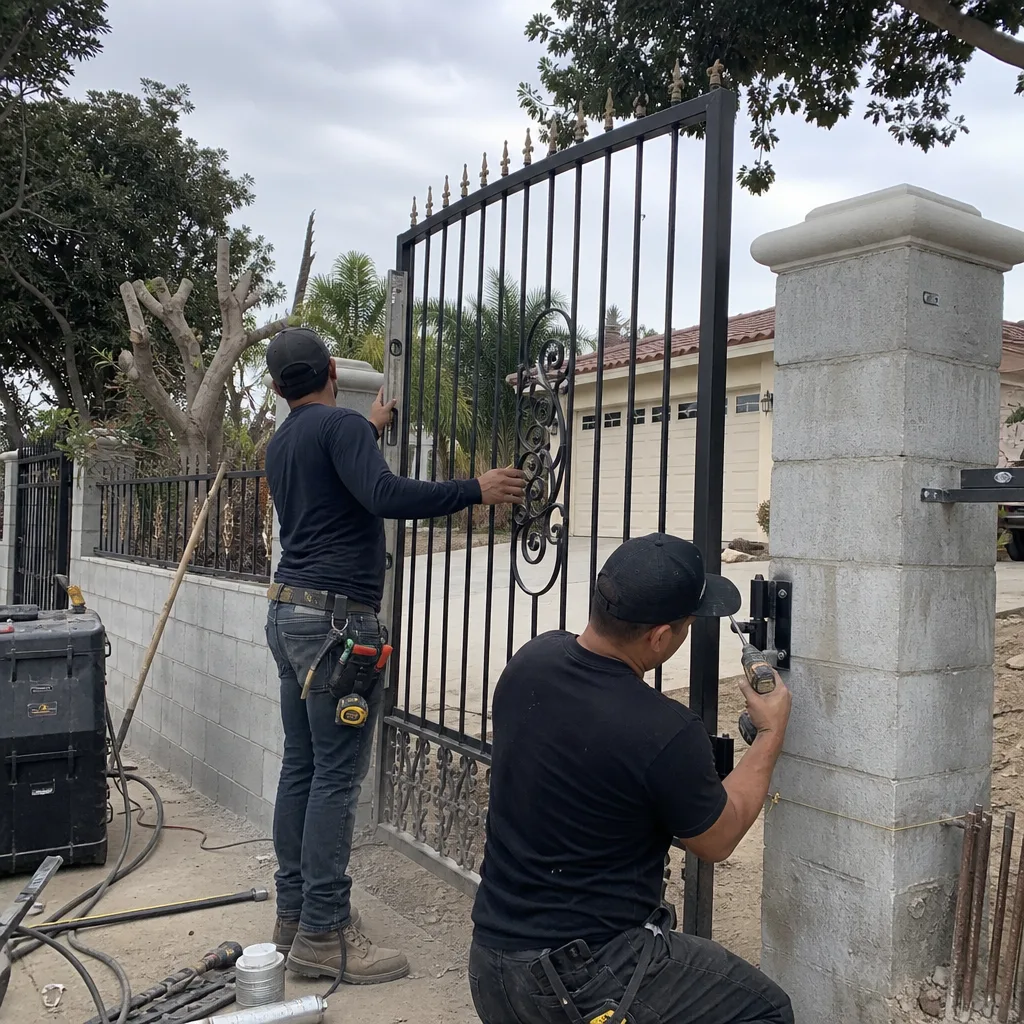
- Replacing the motor before checking the capacitor. In Fontana heat, capacitors die years before motors do. A motor that hums but will not start is usually a $40 capacitor, not a $1,200 motor. Get the diagnostic, not the upsell.
- Ignoring post lean until the gate stops moving. A leaning post grinds the hinges, wears the gear train, and eventually destroys expensive components that were never the root problem. Structural misalignment in Fontana’s caliche soil is a slow killer.
- Accepting a verbal quote. A verbal quote is legally meaningless and practically unverifiable. The price you remember is not the price the company remembers. Get it in writing before work starts, every time.
- Lubricating a sliding gate track with grease. In Fontana dust, grease becomes a grinding paste within weeks. Slide gate tracks need a dry lubricant or none at all, not axle grease from a garage shelf.
- Assuming the photo-eye is broken when the gate reverses. Most “broken” photo-eyes are just misaligned, dirty, or shaded by a new plant. Check the beam alignment before paying for a replacement sensor.
- Replacing a gate rather than fixing the operator. A gate leaf is steel and lasts decades. The operator is electronics and fails predictably. Unless the gate is rusted through or structurally unsound, repair the operator and keep the gate.
- Approving work without a verification step. A technician who installs a part and leaves without cycling the gate ten times has not finished the job. The scope should include testing, and you should see it happen.
When to Call a Professional
Call a professional when the gate reverses for no visible reason more than once, when you hear a grinding or shrieking from the hinges or wheels, when the motor hums but the gate does not move, when the gate has visibly sagged, or when you see sparks, smoke, or a burning smell from the control box. Gate operators are high-tension, high-torque machines. A swing gate arm under load can crush fingers or a hand, and a slide gate weighing several hundred pounds does not negotiate. If the problem involves the motor, the control board, the capacitor, or a structural post, a trained technician with the right test equipment is the correct call. Read our DIY vs Professional Gate Repair: The Fontana Homeowner’s Decision Guide to decide when to call. Do not open a live control box unless you are qualified to work on 120V or 240V circuits.
Vance Gate Repair Fontana offers free estimates in Fontana, and a live person answers at (951) 476-1539 any time, day or night. Name your symptom, and we will name the likely cause and the price range before anyone schedules a visit.
Frequently Asked Questions

Gate repair in Fontana typically costs between $180 and $450 for common fixes like photo-eye realignment, limit switch adjustments, hinge replacement, and capacitor replacement. Motor and control board replacements run between $700 and $1,800 depending on the brand (FAAC, BFT, Linear, Viking all have models at different price points) and whether the gate is a swing, slide, or bi-fold.
- Photo-eye realignment: $85-$165
- Limit switch reset and set point calibration: $120-$220
- Hinge pin and bushing replacement: $180-$350 per leaf
- Capacitor replacement (motor start capacitor): $120-$240 including labor
- Control board replacement: $450-$1,100 depending on brand
- Full motor replacement (swing arm): $700-$1,500 installed
- Full motor replacement (slide gate): $900-$1,800 installed
- Post remediation (caliche soil work): $400-$900 depending on depth and method
- Welded repair (gate leaf crack or hinge plate): $150-$400 depending on extent
These are line-item ranges for Fontana’s market, not firm quotes. Your written scope will show the exact number before any work starts. Call (951) 476-1539 for a free estimate.
Yes. Mechanical repairs like photo-eye realignment, limit switch adjustment, hinge replacement, and capacitor replacement are typically completed the same day in Fontana. Our dispatch responds quickly, and a named technician with a photo and background check is sent to your property. Motor replacements may require a same-day diagnosis followed by a next-day parts pick if your brand is not in stock locally.
This is the classic Fontana heat failure. A solder joint on the control board, or a capacitor that is drying out, will function when the board is cool and fail when the board expands in the afternoon sun. A control box mounted on a west-facing wall in direct summer sun can reach 140°F internally. The fix is component-level diagnosis under load, not a guess. A board that tests good in the morning can be failing by 3 p.m., and a technician who only sees it cold will misdiagnose it.
Sight down the hinge edge of the gate. If the post is plumb but the gate leaf drifts inward or outward, the hinges are worn. If the post itself is out of plumb, the problem is structural. In Fontana, caliche soil movement causes post lean that looks electrical but is not. Either way, the cheapest fix is to address it before the misalignment chews through the gear train and turns a $300 hinge job into a $1,500 motor replacement.
Vance Gate Repair Fontana services nine major gate-automation brands, including FAAC, BFT, Linear, Viking, LiftMaster, Ghost Controls, DoorKing, Elite, and Mighty Mule. We repair whatever motor is already on the property rather than steering you toward a replacement you do not need. If your operator is a brand outside that list, call anyway; the diagnostic will tell us whether it is serviceable.
A proper written scope names the specific part (with part number where applicable), separates parts from labor, lists exclusions, specifies how the repair will be verified, and states the final price in writing before work starts. A quote that says “$900, includes parts and labor” without naming the part is an estimate, not a scope. Ask for the part number and the verification steps. If the company will not put it in writing, find one that will.
The Bottom Line
Gate repair in Fontana is a local problem with a local solution. The heat, the dust, and the caliche soil that make Fontana what it is also determine what breaks, when it breaks, and in what order. A photo-eye that fails in August is not bad luck; it is a heat-expansion problem. A gate that sags in March is not a motor issue; it is post movement in caliche soil. This guide should give you the vocabulary to describe what you are seeing, the sequence to know what likely failed, and the standard to demand from any repair: a written price before work starts and a documented record when the technician leaves. That is how Gate Repair should work in Fontana, and how it does work at Vance Gate Repair Fontana.
Written by Adrian Vance, Owner at Vance Gate Repair Fontana, serving Fontana since 2014.