
Last updated September 20, 2026
Free on-site gate assessment - hinges, posts, and your LiftMaster or Nice gate operator checked before anything is quoted
The assessment is free and the quote is the invoice.
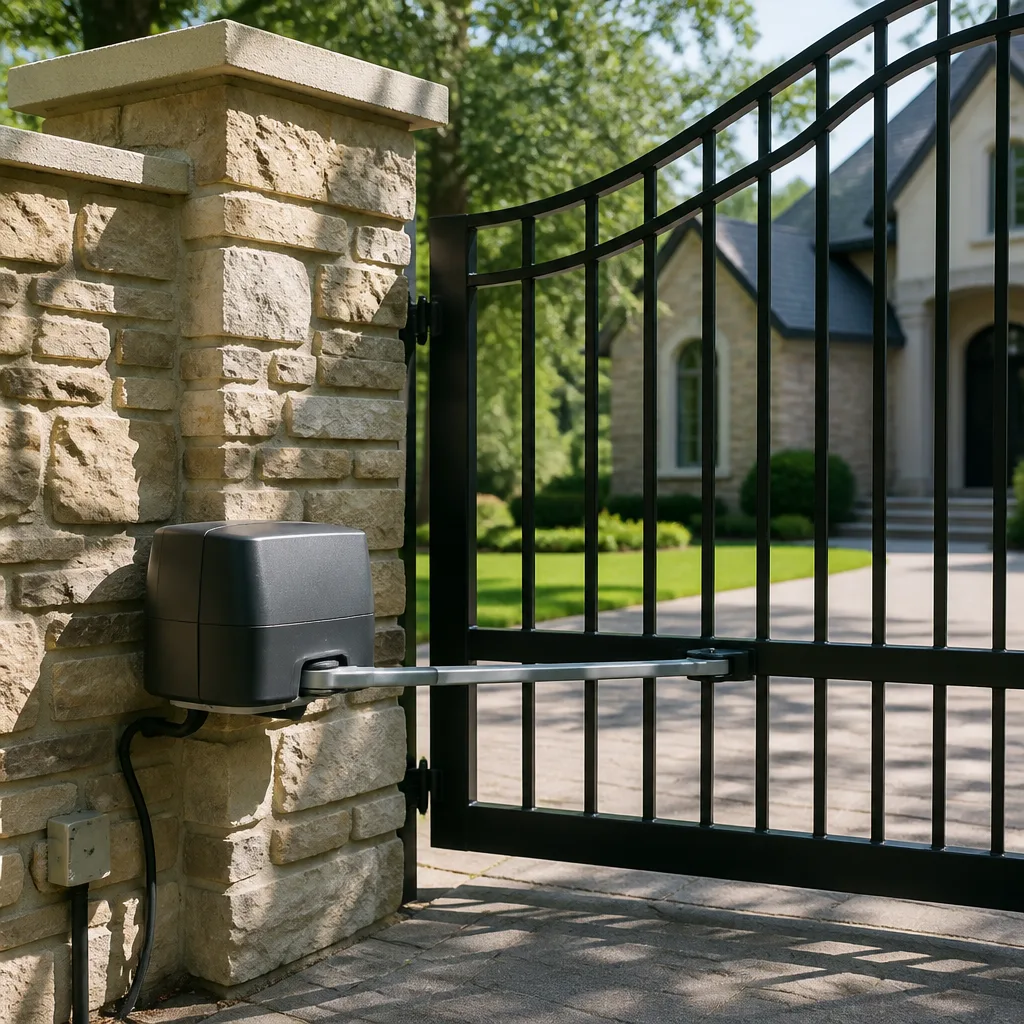
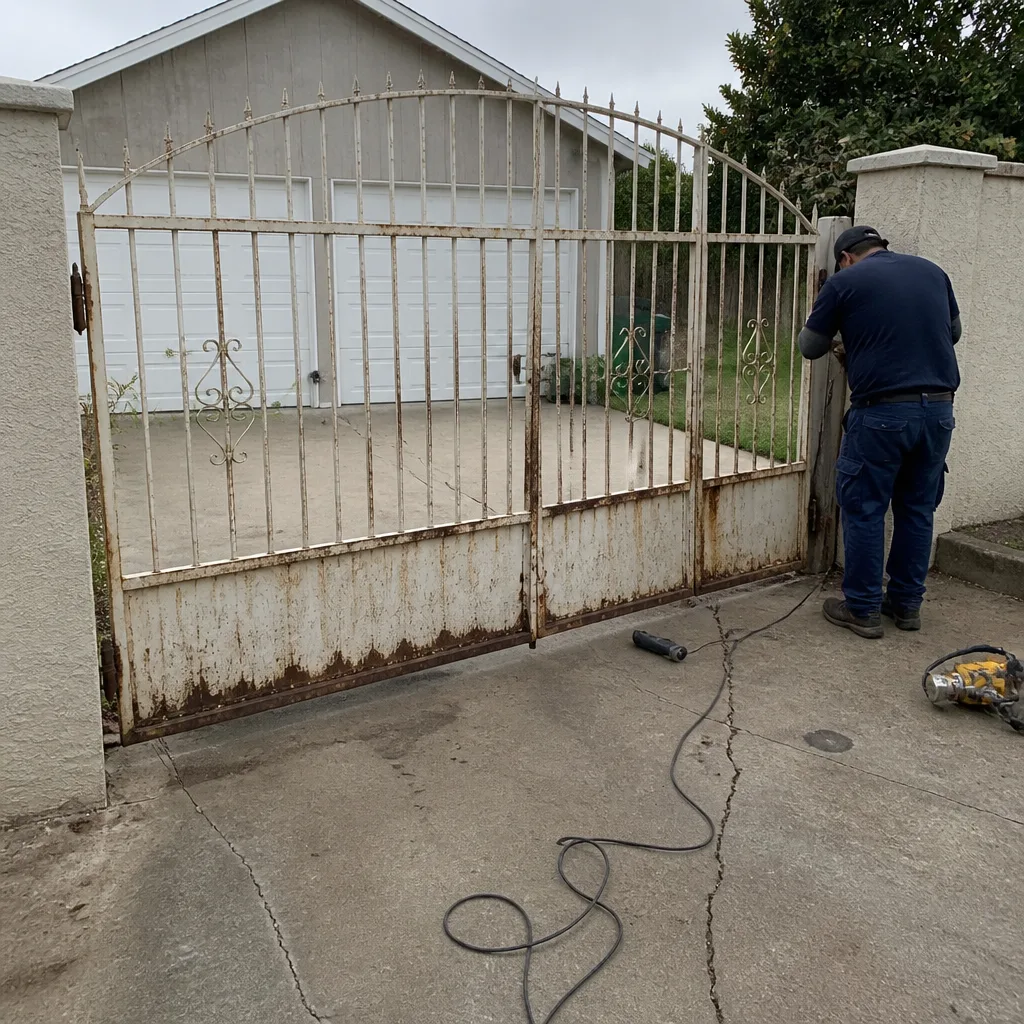 Before
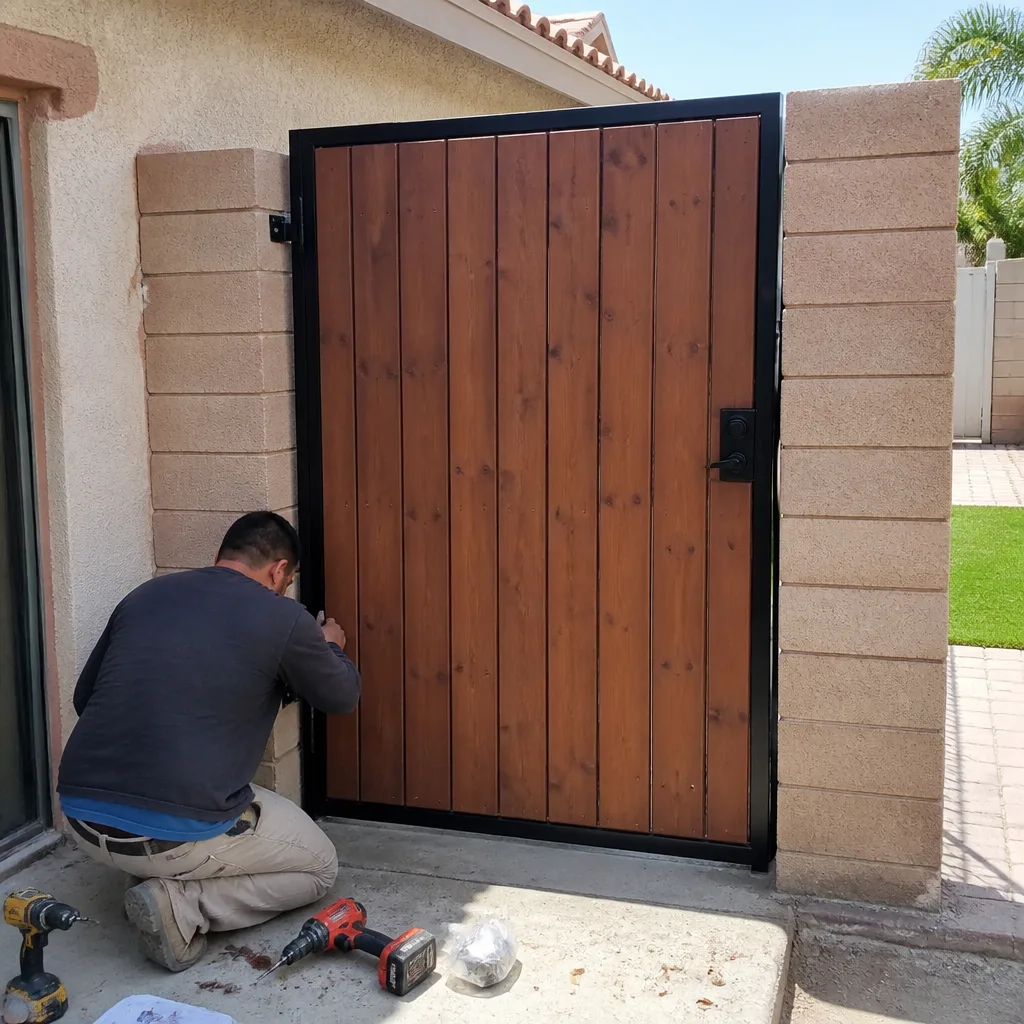 After
After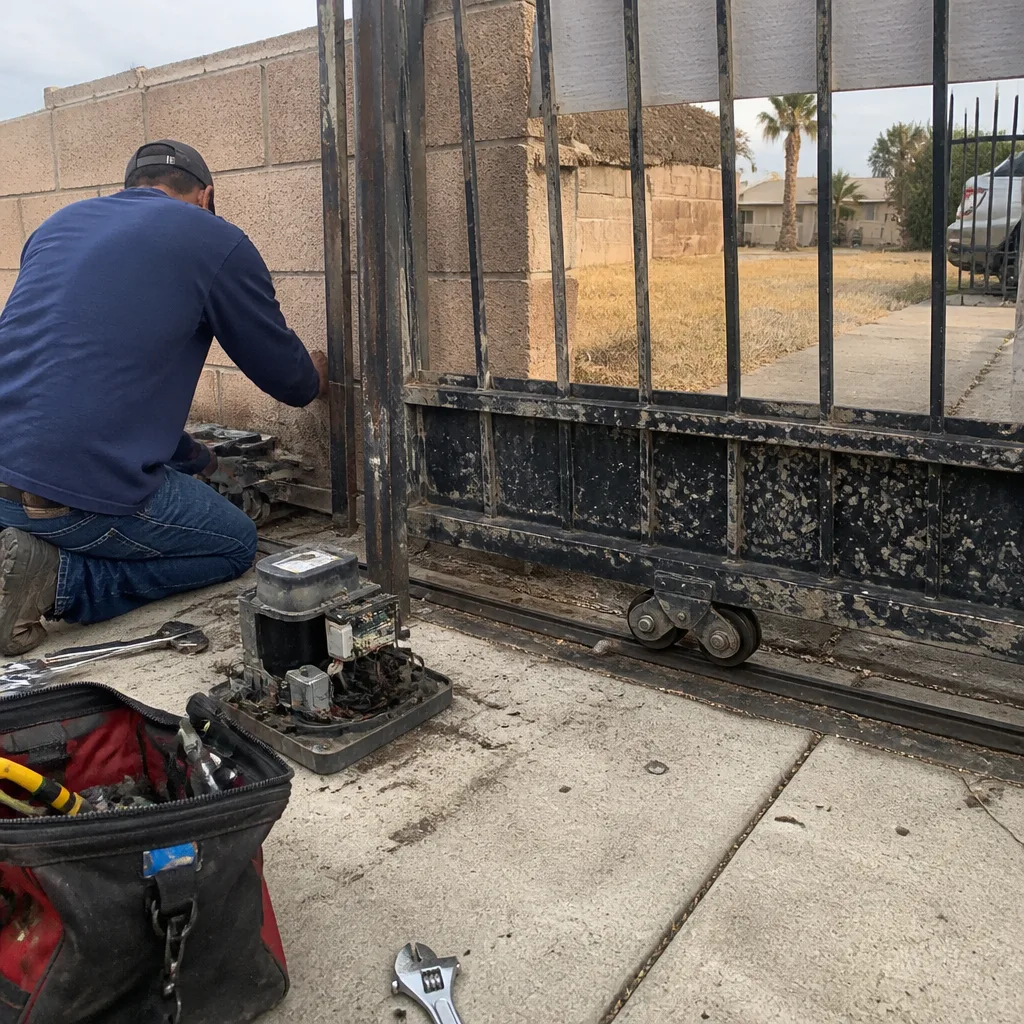 Before
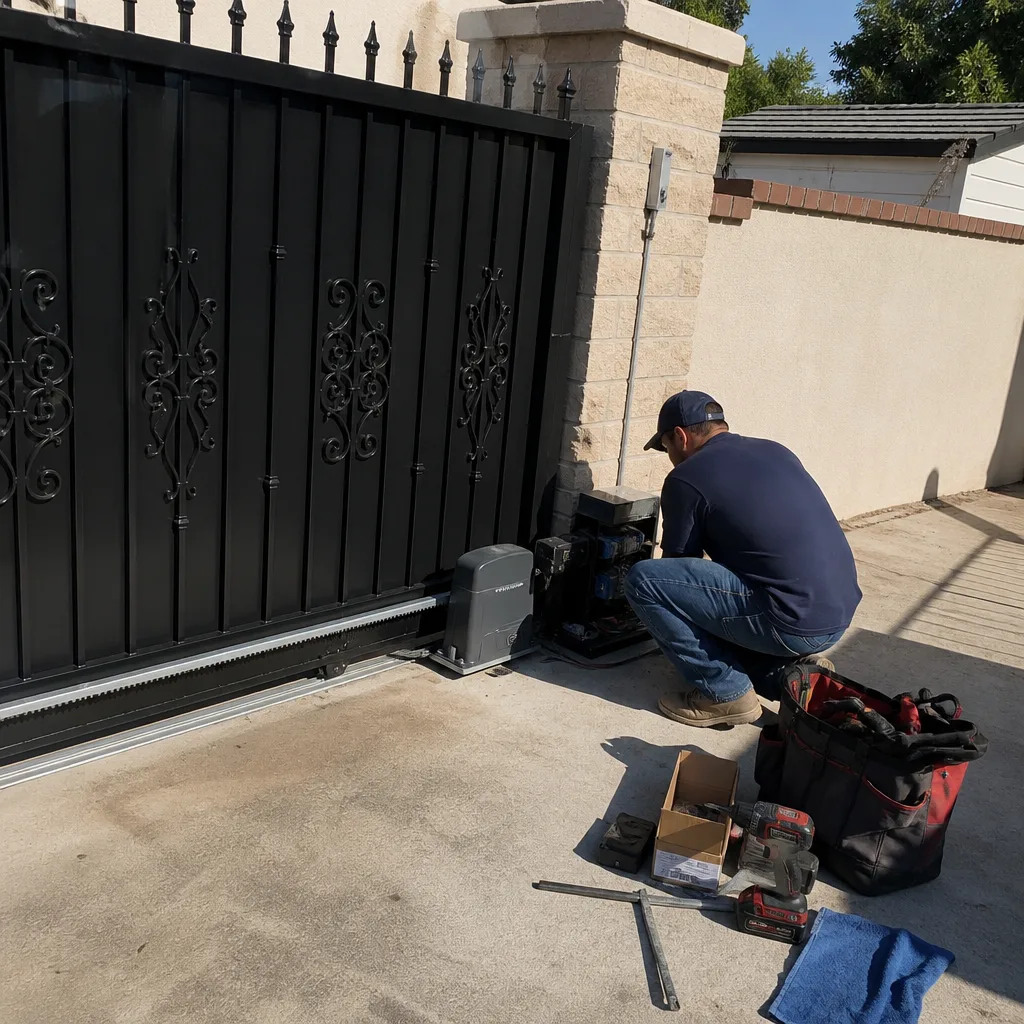 After
After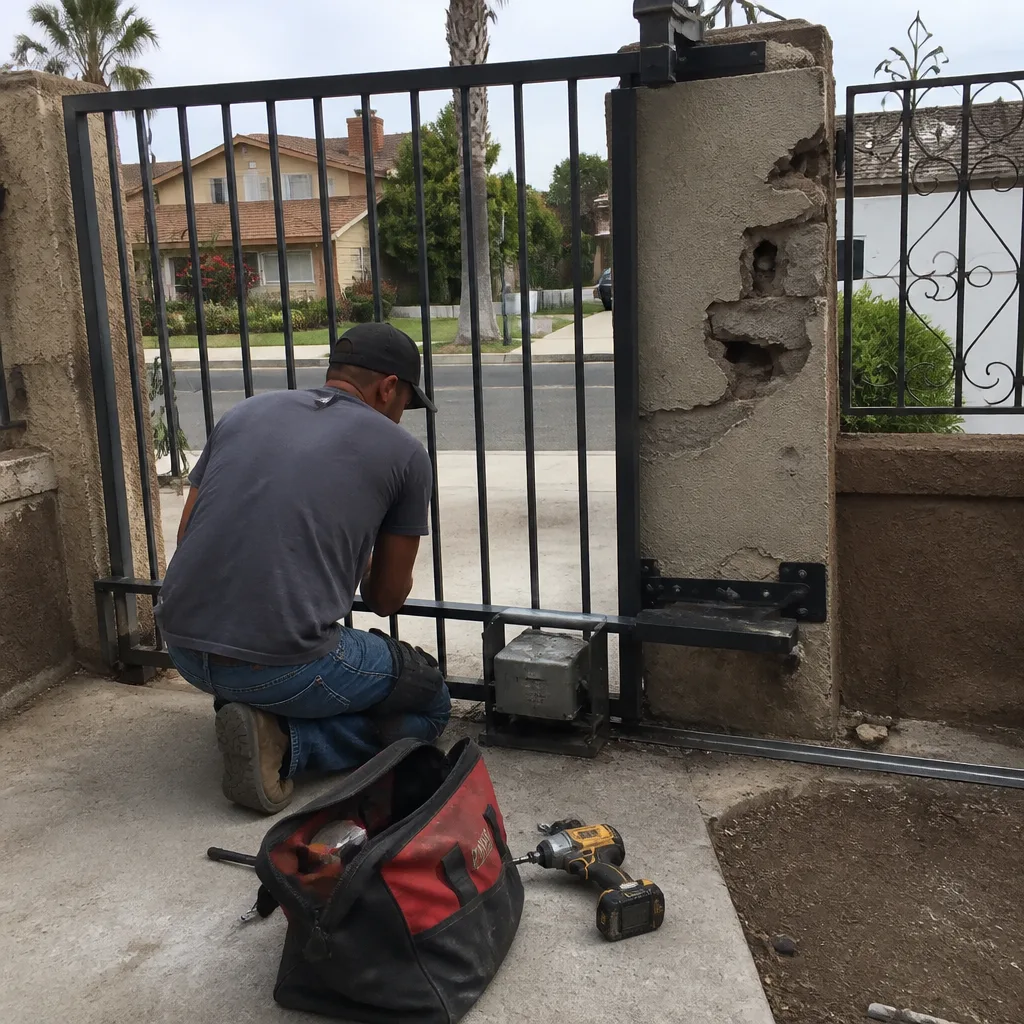 Before
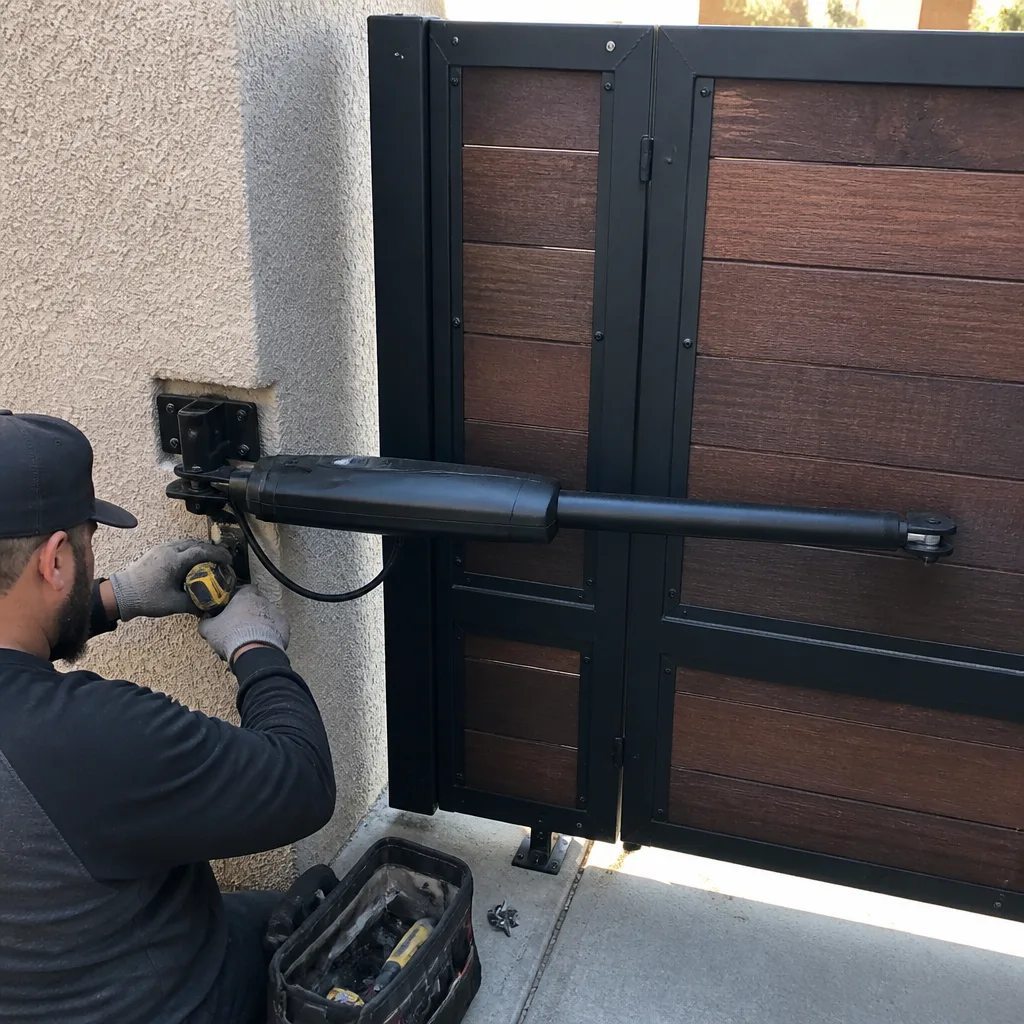 After
AfterGate Repair Warning Signs: A Fontana Homeowner’s Reference Guide
A gate that hesitates for two seconds before moving isn’t “breaking in.” It’s drawing excess current through a failing capacitor, and within 30 days that hesitation becomes a no-open. We’ve watched it happen hundreds of times across Fontana, from Northgate to South Ridge to the newer developments west of the 15. The gate didn’t fail suddenly. It warned first, and the warning got filed under “I’ll get to it.” This guide maps every common symptom to the component actually causing it, what it costs to fix now versus later, and what to photograph before you call anyone. If your gate does any of the things described below, you’ll know exactly what you’re looking at by the time you finish reading.
Quick Answer
The most common gate repair warning signs in Fontana are hesitation before movement, grinding or screeching during travel, reversing mid-cycle, sagging that worsens over months, and slow response from remotes or keypads. Each symptom points to a specific component: a capacitor, a drive gear, a limit switch, a hinge, or a transformer. Catching any of them early typically costs $120 to $350 to repair; waiting until the component fails completely usually means $600 to $2,400 for a motor replacement, board replacement, or full hinge and post rebuild.
Table of Contents
- Symptom-to-Component Mapping: What Your Gate Is Actually Telling You
- Fontana Dust and False Obstruction Reversals: The Misdiagnosis That Costs Homeowners Twice
- Signs You Can Schedule Versus Signs That Mean Stop Using the Gate Today
- What to Photograph and Measure When You First Notice a Symptom
- The Cost Delta: What Early Repair Versus Full Failure Actually Looks Like in Dollars
- What You Can Safely Check Yourself, and What You Should Never Touch
- Why Documentation Matters: What a Proper Gate Repair Record Should Include
- Common Mistakes to Avoid
- When to Call a Professional
- Frequently Asked Questions
- The Bottom Line
BeforeAfterSymptom-to-Component Mapping: What Your Gate Is Actually Telling You
A driveway gate is a simple machine: motor, drive mechanism, control board, sensors, hinges, and the gate leaf itself. Every failure mode produces a distinct, observable behavior. The problem is that most homeowners describe the behavior in general terms (“it’s acting weird”) while the technician needs the specific symptom. Here is the mapping, from what you see to what’s actually wrong.
Hesitation Before Movement: Failing Capacitor
You press the remote. Nothing happens for two, three, four seconds. Then the gate lurches into motion. That delay is the motor struggling to build starting torque, and the most common cause on residential swing and slide gates is a capacitor that has degraded. Capacitors store the electrical charge needed to kick the motor from rest into motion. In Fontana’s heat, capacitors fail faster than in coastal climates; sustained temperatures above 95 degrees accelerate the breakdown of the dielectric material inside. We replace capacitors on LiftMaster and Mighty Mule operators in Fontana at roughly twice the rate we see in cooler inland areas. A capacitor replacement runs $85 to $180 installed, depending on the operator model. The motor replacement you’ll need if you ignore it: $450 to $900.
Grinding or Screeching During Travel: Drive Gear or Chain
Metal-on-metal grinding is a drive gear losing teeth. A high-pitched squeal is usually a chain that has stretched past its adjustment range, or a belt drive with a worn idler pulley. Neither sound is cosmetic. Each rotation with a stripped gear grinds the motor against increasing resistance, which raises current draw, which heats the windings, which shortens the motor’s life every single cycle. In Fontana, we also see a specific pattern on gates facing unshaded south exposure: the grease in the gearbox breaks down faster, leaving gears running dry. A gear or chain replacement is $150 to $400. A gearbox and motor assembly, which is where you’ll be within six to twelve months of ignoring the noise, starts at $700 and goes up from there, depending on the operator brand and model.
Reversing Mid-Cycle: Limit Switch or Obstruction Sensor
A gate that starts closing, reverses, tries again, and gives up is usually the limit switch telling the control board “the gate traveled too far, stop.” Limit switches are small mechanical or magnetic sensors that tell the board where the gate is in its travel. When they drift out of adjustment, the board thinks the gate has hit something and reverses it. The fix is often a 20-minute adjustment; we’ve done it on FAAC and BFT operators across Fontana where the switch had slipped a few degrees. The other cause is a photo-eye misalignment: the infrared beam that stops the gate if something crosses the path. A photo-eye off by two inches behaves exactly like a limit switch problem. The diagnostic difference matters because adjusting a limit switch costs around $95 to $150, while replacing a photo-eye assembly is $120 to $250.
Sagging: Hinge or Post, Not the Gate Leaf
When a gate drags on the ground or scrapes the latch post, most people assume the gate itself is bending. In our experience across Fontana, it’s usually the hinge hardware wearing or the post shifting in the soil. Fontana’s clay-heavy soil expands and contracts with moisture, and over years that movement works gate posts loose, especially on the downhill side of a sloped driveway. A sagging gate puts load on the operator that it was never designed to carry, which burns out motors and twists arms. Hinge replacement on a standard steel gate runs $150 to $400. A post that needs to be dug out, reset in concrete, and re-plumbed is $500 to $1,200. What’s not optional: continuing to run a gate that drags. That’s how a $200 hinge problem becomes a $2,000 operator and gate rebuild.
Slow Response from Remotes or Keypad: Battery, Transformer, or Board
If remotes work intermittently at ten feet but not thirty, replace the remote battery first; that’s a $3 fix. If the keypad is slow to respond or the gate cycles slowly after any command, the issue is usually the transformer supplying low-voltage power to the control board, which in turn affects how the board processes inputs from all devices. A transformer replacement is $100 to $200. A control board replacement, which becomes necessary when a failing transformer sends irregular voltage into the board long enough, is $300 to $900 depending on the automation brand. BFT and Viking boards sit at the higher end; Ghost Controls and Mighty Mule at the lower.
Understanding what each symptom means is the first step. The second is recognizing that some of these signs are urgent while others allow you to schedule a call. For a complete picture of what gate repair in Fontana involves from diagnosis to documentation, our service page covers the process from the technician’s side.
Fontana Dust and False Obstruction Reversals: The Misdiagnosis That Costs Homeowners Twice
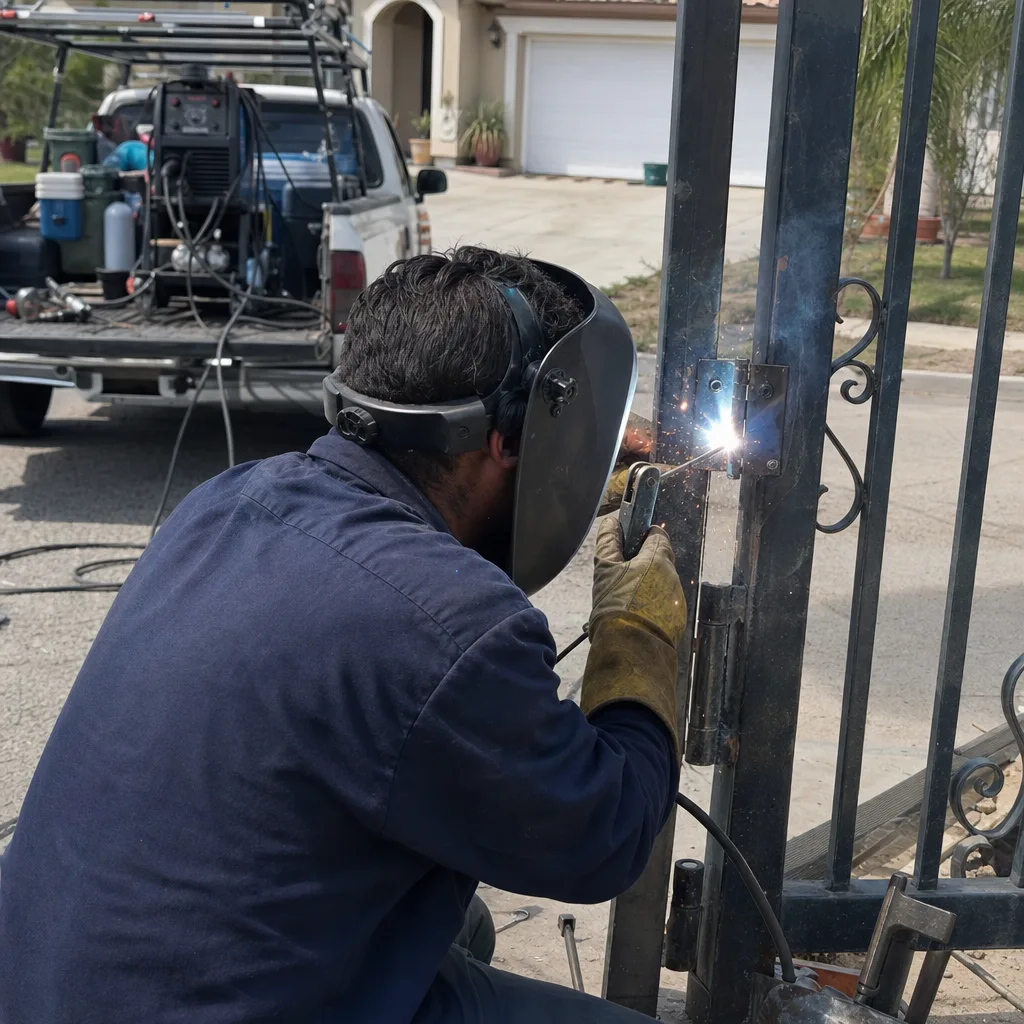
Here is the symptom pattern we see more in Fontana than anywhere else in the Inland Empire: the gate reverses for no reason. No dog. No car. No child. Nothing in the path. The homeowner calls a technician, the technician checks the photo-eye alignment, finds it within tolerance, shrugs, and charges a service fee. The gate reverses again the next week. The homeowner calls a second company. Same result. By the time it reaches us, the homeowner has paid twice for the same undiscovered problem.
The cause, in most of these cases, is dust contamination on the control board. Fontana sits in the path of Santa Ana wind events and daily dust kicked up from the 15, the 210, and the quarries to the north. That dust is fine enough to work its way into control board enclosures, even ones rated for outdoor use. It settles on the board’s obstruction-sensing circuitry. When enough dust accumulates, the board reads the dust as an obstruction and reverses the gate. It is not a sensor problem. It is a contamination problem.
Here is how the misdiagnosis harms you financially: you pay $95 to $150 for a technician to check sensors that are fine. The problem continues. You pay a second visit fee, or worse, someone sells you new photo-eyes you didn’t need for $250. The actual fix, in most cases, is booting the board out of its enclosure, blowing out the contamination with low-pressure air, cleaning the contacts, and applying a corrosion inhibitor. That work, done properly, runs $150 to $250. If the contamination has been sitting long enough to cause corrosion across traces on the board, the repair becomes a board replacement: $300 to $900.
What to check before you call:
- Open the control box (with the power off, if you’re comfortable doing so) and photograph the board
- Look for fine gray-brown dust coating, not just on the board surface, but around the terminal connections
- Note whether the false reversals happen more on windy days or after Santa Ana events
- Send those photos to the technician before they dispatch, so the diagnostic visit is confirmation, not discovery
This is the single most Fontana-specific gate issue we deal with, and the one where an informed homeowner saves the most money. If your gate has started reversing unpredictably and you’re in Fontana, dust-on-board is the first hypothesis, not the fifth.
Signs You Can Schedule Versus Signs That Mean Stop Using the Gate Today
Not every warning sign is an emergency. Some allow you to book a repair for next week without risking the gate’s long-term health. Others mean the gate should be opened manually, disconnected from the operator, and left alone until a technician arrives. Knowing which is which prevents both unnecessary panic and unnecessary damage.
Schedule a Repair Call: These Are Urgent, But Not Dangerous
- Hesitation before movement - capacitor failing; repair within 2-3 weeks
- Slow remote response - battery or transformer; repair within 2-3 weeks
- Grinding that started recently - drive gear wear; repair within 1-2 weeks
- Intermittent false reversals - possible dust contamination; repair within 2-4 weeks, and reduce dust exposure by not running the gate during windy days
- Mild sag (gate visibly lower but not dragging) - hinge wear; repair within 1-2 months
Stop Using the Gate Today: These Are Dangerous or Destructive
- Gate drags on the ground or scrapes the latch post - every cycle loads the operator beyond spec and risks sudden hinge failure
- Gate slams shut or opens with more force than it used to - limit switch has failed entirely; the gate can strike a person, vehicle, or pet
- Visible metal fatigue: cracks, rust-through, or broken weld at hinge points - a gate leaf that breaks free can injure or kill
- Electrical burning smell from the control box - shut the breaker off and leave it off
- Sparks, smoke, or a hot motor housing - motor windings are failing; fire risk is real
In an emergency, disconnect the operator (usually a pull-lever or release knob on the motor housing) and operate the gate manually if it will move freely. Lock it in the open or closed position with a chain and padlock if you have one. Then call. A live person answers at Vance Gate Repair Fontana at any hour, because a gate emergency at 2 a.m. doesn’t wait for business hours.
What to Photograph and Measure When You First Notice a Symptom
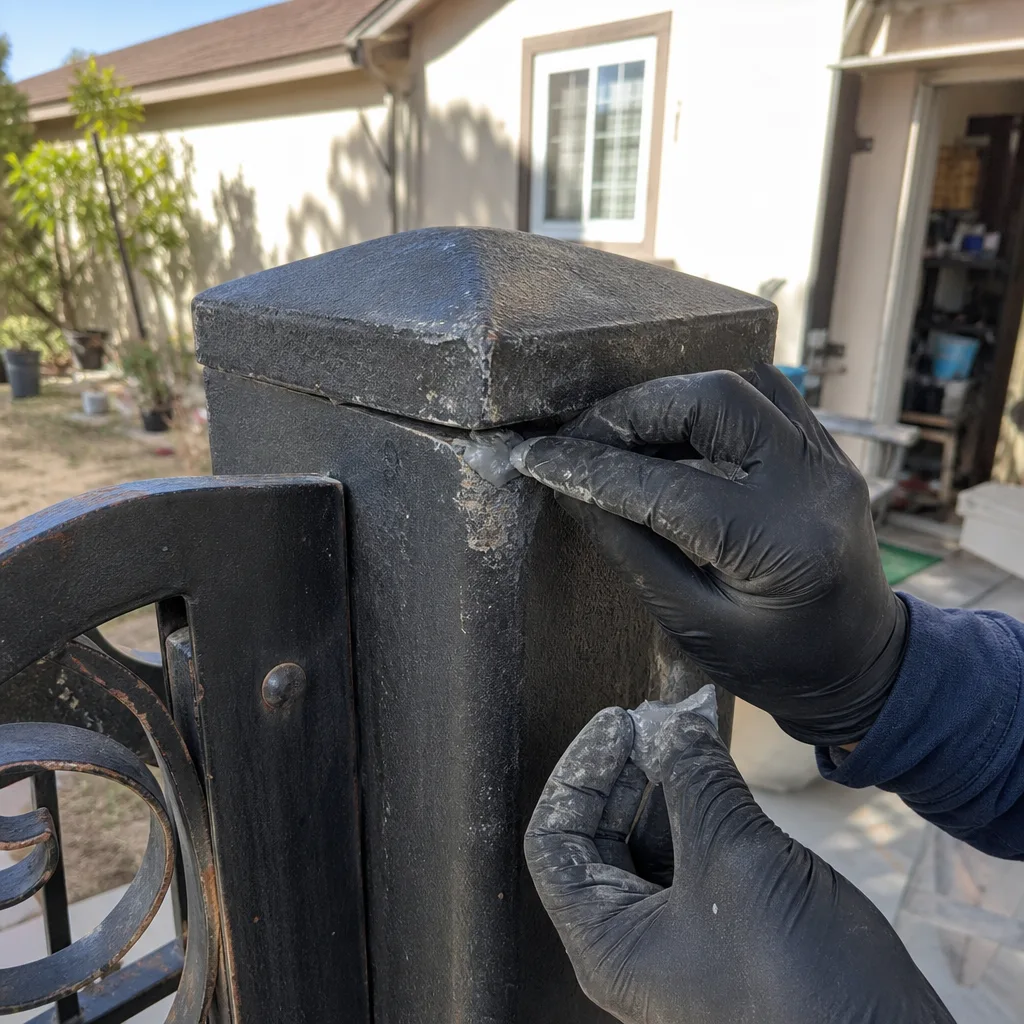
The most expensive diagnostic visit is the one where the technician spends 45 minutes figuring out what you could have told them before they arrived. The second most expensive is the visit where the symptom doesn’t reproduce while the technician is on site, so they leave with “couldn’t find anything wrong” and the problem returns that evening. Both are avoidable with documentation.
We’ve built our entire process around this principle. Every visit we do includes a photographic record of what was found, what was adjusted, and what was installed. You don’t need to be a technician to create a basic version of that record on your end. Here is what to capture when a symptom first appears:
- Video the symptom. A 10-second phone video of the gate hesitating, grinding, or reversing mid-cycle is worth more than a paragraph of description. Capture it twice if possible: once on a cycle you trigger, once during a normal cycle.
- Photograph the operator and control box. Get the brand name and model number on the motor housing. LiftMaster, FAAC, BFT, Mighty Mule, Ghost Controls - the model number determines which parts are compatible and what the repair should cost.
- Photograph the hinges and the gate-post connection points. If sag is the issue, get both sides of each hinge, from below if possible, showing how much metal remains.
- Measure the gate leaf. Width and height, in feet. A 12-foot gate has different hardware needs than a 16-foot gate, and knowing the dimensions before dispatch saves a trip back to the shop.
- Note when the symptom happens. After a rain? Only in late afternoon heat? Only after the gate has been sitting closed for hours? Timing is a diagnostic clue. In Fontana, heat-related capacitor failures tend to show up in late afternoon, after the gate has baked in direct sun all day.
- Check and record the breaker. If the gate is on a shared circuit with landscape lighting or a pool pump, note that. Voltage drops from shared-circuit loads cause symptoms that look like motor or board failures but are actually electrical supply problems.
This takes ten minutes. It saves you a diagnostic charge, and it tells the technician you’re informed, which changes the conversation. You’ve already done the discovery; the technician’s job becomes confirmation and repair. If you’re planning a larger service like a full replacement, see what gate installation in Fontana involves so you can compare an honest repair against the cost of starting fresh.
The Cost Delta: What Early Repair Versus Full Failure Actually Looks Like in Dollars
Here is the table we wish every Fontana homeowner saw before their gate failed. These are real numbers from our repair records, not hypotheticals, and they reflect what we actually write on estimates in this market.
| Symptom | Catch It Early: Repair Cost | Wait Until Failure: Replacement Cost |
|---|---|---|
| Hesitation before movement | Capacitor: $85-$180 | Motor: $450-$900 |
| Grinding or screeching | Gear or chain: $150-$400 | Gearbox + motor: $700-$1,800 |
| Reversing mid-cycle | Limit switch adjustment: $95-$150 | Board damage from repeated fault cycles: $300-$900 |
| Gate sagging, not yet dragging | Hinge replacement: $150-$400 | Post reset + operator + gate rebuild: $1,200-$3,500 |
| Slow response | Transformer or battery: $100-$200 | Control board: $300-$900 |
| False reversals in Fontana dust | Board cleaning: $150-$250 | Corroded board replacement: $300-$900 |
The pattern is consistent: early repair costs roughly a third of what full failure costs. The reason is mechanical cascade. A failing capacitor draws excess current. Excess current heats motor windings. Hot windings degrade insulation. Degraded insulation shorts windings. A shorted motor is dead. Same chain with a grinding gear: lost teeth mean slipping, slipping means the motor spins against intermittent load, intermittent load means current spikes, current spikes kill the control board’s driver transistors. One component fails, then the next in line, then the next. In Fontana’s heat and dust, this cascade happens faster than in milder climates.
For gates where the operator itself is beyond saving, the math changes. A full gate motor and opener replacement in Fontana typically runs $800 to $2,400, depending on the brand and the gate’s size and weight. Our service page breaks down that range by motor type and what’s included.
What You Can Safely Check Yourself, and What You Should Never Touch
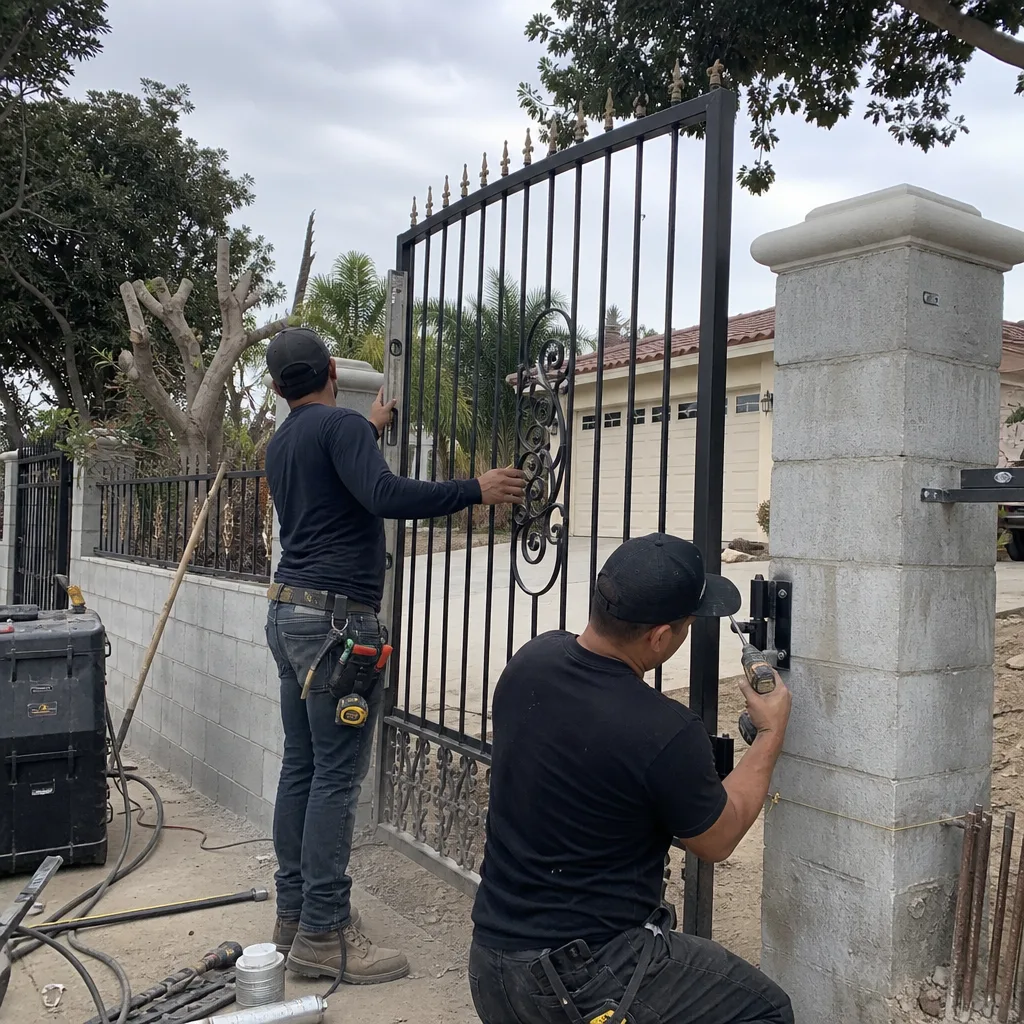
We believe an informed homeowner is easier to serve well. But there’s a line between checking and repairing, and that line matters because the high-tension components on a gate can cause serious injury. Here is where we draw it.
Safe to Check and Do Yourself
- Replace remote and keypad batteries. The $3 fix is real. Change batteries once a year, whether they’re dead or not.
- Clear debris from the gate track or path. A rock jammed in the track is not a sensor failure. Move it. Close the gate. Problem solved.
- Wipe down photo-eye lenses. Dust and spider webs on the lens face cause false obstruction signals. A dry cloth fixes it in 30 seconds.
- Tighten visible screws on the gate frame and latch hardware. Use a screwdriver, not a drill. If a screw spins without tightening, the hole is stripped and needs a professional repair.
- Photograph and document the symptom as described above. That’s your most valuable contribution to the repair.
Never Touch These Without Training
- Gate springs and torsion hardware. A gate spring under tension stores more than enough energy to break bone. If the spring is broken, cracked, or sagging, call someone.
- Control board wiring. Even at low voltage, the board controls 120V or 240V power to the motor. One wrong connection can turn the board into a fire hazard or turn a “repair” into a “replace.”
- Limit switch adjustment inside the operator housing. This is a precise mechanical setting. A limit switch set past its travel limit will burn a motor out in weeks.
- Anything requiring the operator housing to be opened while the unit is powered. Include this in your mental list of things that can kill you or burn the house down. It’s not an exaggeration.
- Post resetting or hinge welding. The loads a gate post carries are structural. An improperly set post fails suddenly, and a failed post with a gate attached is a thousand-pound lever.
The rule we give every Fontana customer: if it’s low-risk and reversible (a battery, a lens wipe, a pebble in the track), do it yourself. If it’s energized, tensioned, structural, or requires a tool you wouldn’t use on your car, call us. High-tension springs and electrical components are exactly the kind of thing where a professional’s $150 service call is the cheapest insurance you’ll ever buy.
Why Documentation Matters: What a Proper Gate Repair Record Should Include
Here is the problem with most gate repair visits: the technician arrives, fixes the thing, says “all set,” and drives away. You have no record of what was touched. Six months later, a different symptom appears, and the next technician starts from zero. They can’t tell if this problem is related to the last one. They can’t tell if the last repair was done correctly. You pay for the same discovery twice.
We built Vance Gate Repair around fixing this specific failure. Adrian Vance came out of commercial access-control work starting in 2014, where documentation isn’t optional, it’s contractual. A commercial site’s security audit can demand records of every relay swapped and every board programmed. Residential gates deserve the same record, and in our experience, homes with documented gate history are repaired faster and cheaper every time.
What a proper repair record includes:
- Photos, taken before and after. The worn gear next to the new gear. The misaligned limit switch next to the corrected position. The contaminated board next to the cleaned board.
- Written scope. The price you agreed to is the price you paid. Written before work starts, not after. This is Haven Standard Clause 1: have it in writing.
- Complete parts list. Brand, model number, part number. If a future technician sees that a LiftMaster capacitor model 030B0568 was installed in 2025, they know exactly what’s in there without opening anything.
- Settings and measurements recorded. Limit switch positions, force settings, beam alignment ranges. The numbers, not a vague description.
- Warranty terms on the installed parts. Manufacturer warranty on parts, our 365-day Done Right Promise on labor. All in writing.
If you have a previous technician’s record, bring it out when the next issue arises. It shortens the diagnostic visit and prevents the “wait, who worked on this last?” guessing game. If you don’t have one, start creating your own with photos and notes, and choose a company that provides one as a matter of policy.
Common Mistakes to Avoid

- Ignoring a noise because “it still works.” A grinding gear is audible evidence of metal being destroyed. “Still works” means “still failing.” Every cycle you run it is another cycle of damage.
- Buying a universal remote before checking the battery. We see this constantly. A $3 battery fix gets skipped; a $50 universal remote gets programmed; the gate still acts up because the problem was never the remote.
- Adjusting the photo-eyes by eye. A beam off by a quarter-inch at the emitter becomes several inches at a 20-foot gate. Eye-balling alignment doesn’t work. This is what measurement tools are for.
- Lubricating the gate track with WD-40. WD-40 is a water displacer, not a lubricant. It washes out the grease that was doing the job and leaves behind a residue that attracts Fontana’s dust. Use lithium grease on metal-to-metal contact points, and use it sparingly.
- Running the gate during a Santa Ana wind event if false reversals have started. Every dusty cycle adds contamination to the board. The windstorm isn’t the time to test the gate.
- Getting one quote and treating it as the market price. Gate repair pricing in Fontana varies by hundreds of dollars for the same job. Get a second opinion. We review any written estimate from another company for free, because a written quote is evidence, and evidence can be compared.
- Waiting until the gate stops working entirely. By the time it won’t move, the cascade has already hit the motor, the board, or both. The window for a $150 fix closes before most people notice it was ever open.
When to Call a Professional
Call when the symptom is structural (sag, cracks, dragging), electrical (smell, sparks, no power), or persistent (any symptom that recurs within a week of temporary improvement). Also call before you spend money on parts you’re not sure you need: a diagnostic visit costs less than a wrong part guess. In Fontana, the heat and dust compress timelines; what would be a “keep an eye on it” issue in a milder climate becomes a “handle it this month” issue here. Vance Gate Repair Fontana offers free estimates in Fontana; call (951) 476-1539 and a technician will be dispatched with a written scope, a written price, and a documented record of everything found and fixed.
We’re at Vance Gate Repair Fontana home if you want to review our process before you pick up the phone.
Frequently Asked Questions
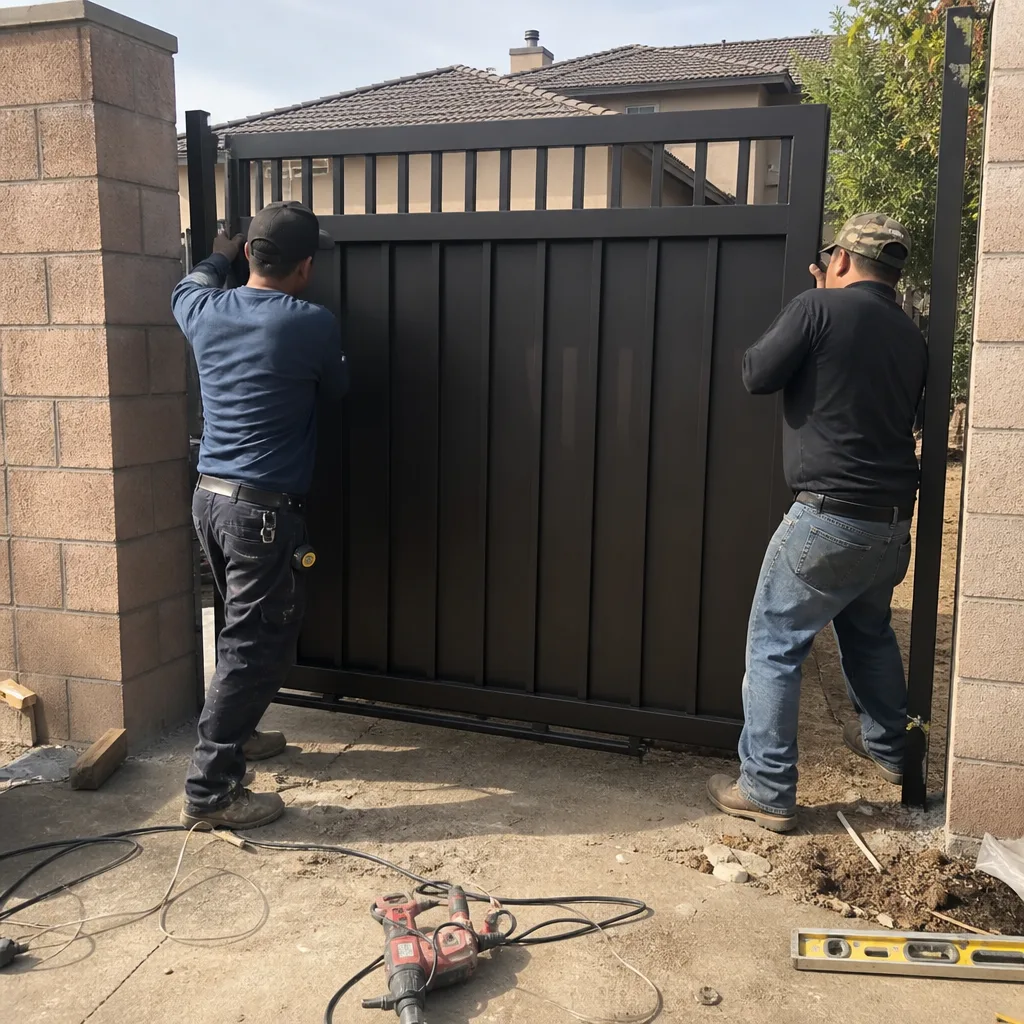
Most gate repairs in Fontana run $120 to $400, with the specific price depending on the component and the operator brand. Capacitor replacement runs $85 to $180, gear or chain replacement $150 to $400, limit switch adjustment $95 to $150, and control board replacement $300 to $900. Prices are quoted in writing before any work begins. Call (951) 476-1539 for an exact quote; estimates are free.
Yes. A live person answers the phone 24 hours a day, seven days a week, and emergency repairs are dispatched same-day when the situation warrants it. For non-emergency symptoms that you’ve documented, we’ll schedule a diagnostic visit at the earliest available time. Call (951) 476-1539 and describe the symptom; you’ll get an honest assessment of urgency.
Our Gate Installation in Fontana process includes a site measurement, gate and hardware selection matched to your driveway’s slope and width, operator installation, safety sensor configuration, and a full documented record of the work with photos and part numbers. Every installation is priced in writing before any work starts.
Yes. We handle the complete electrical scope on gate installations: power run from the panel to the operator, low-voltage wiring for photo-eyes and edge sensors, and programming the operator for the gate’s weight and travel. Safety edges and photo-eyes are installed and tested on every job, not offered as an optional add-on.
It might be the sensors, but in Fontana the more common cause is dust contamination on the control board. If you’ve already had a technician check the photo-eyes and they were aligned, have the board inspected and cleaned before paying for replacement parts. A board cleaning runs $150 to $250; a board replacement, if the contamination has caused corrosion, runs $300 to $900. Call (951) 476-1539 for a diagnostic visit with a written quote.
In our experience, a well-maintained gate motor in Fontana lasts 7 to 12 years, with several factors shortening that: unshaded south exposure, daily cycling (more than 10 cycles per day), and dust intrusion into the operator housing. Heat accelerates capacitor degradation; dust accelerates control board contamination. Both are fixable early with regular inspection. If your motor is acting up, start with diagnosis before replacement; our Gate Motor & Opener in Fontana page covers the service in detail.
The Bottom Line
Gate failure doesn’t happen without warning. It happens when the warning is noticed and then rationalized. Hesitation is a capacitor. Grinding is a gear. Reversing is a limit switch or a dusty board. Sagging is a hinge or a post. Each has an early-repair price between $85 and $400, and each has a late-repair price between $450 and $3,500. The window between those two prices is anywhere from two weeks to two months, and in Fontana’s heat and dust, it closes faster than you’d expect. Photograph the symptom. Name the component. Get a written price before anyone touches it. And keep the record.
Written by Adrian Vance, Owner at Vance Gate Repair Fontana, serving Fontana since 2014.